



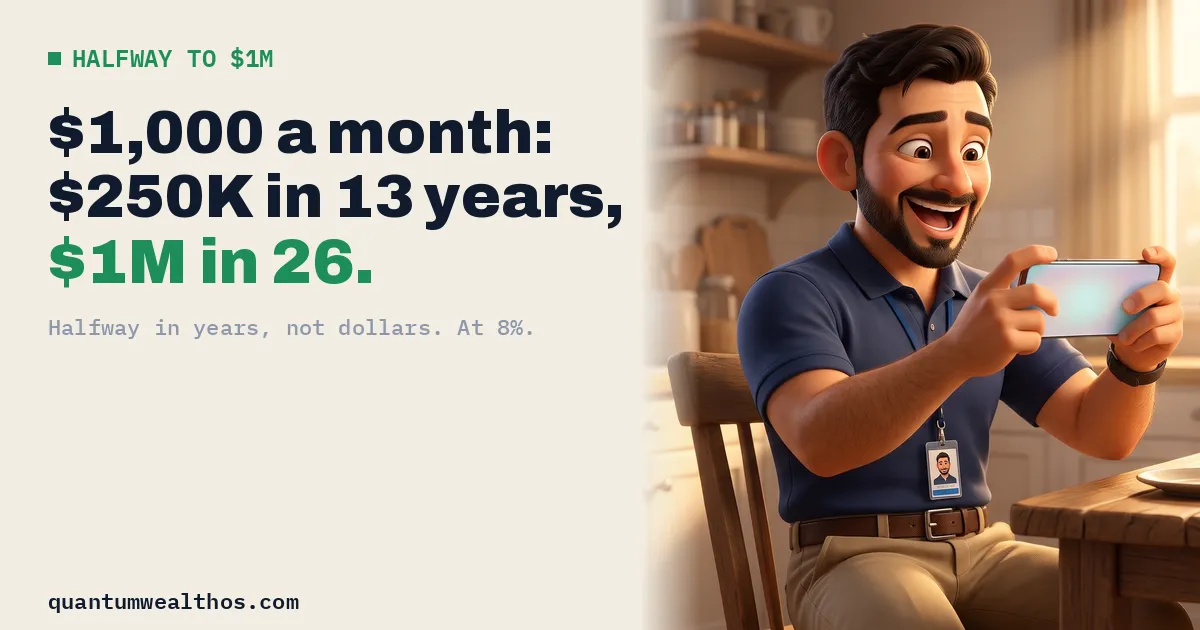
Marcus is 40, and he just saw a headline that made him laugh: $250,000 is halfway to a million. A quarter of a million is not half. He’s right about the dollars. He’s wrong about the time.
The Rule of 72
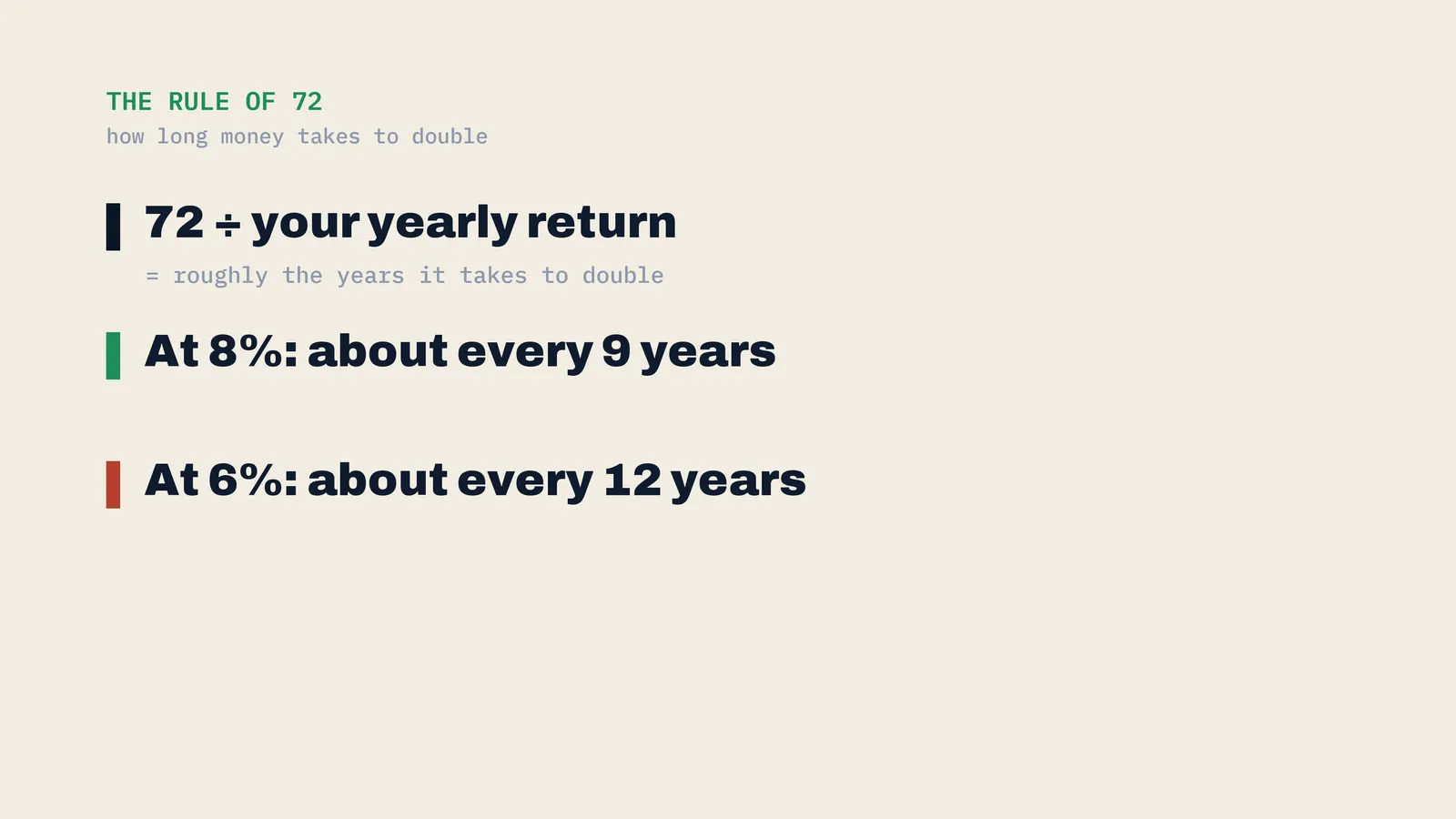
Divide 72 by your yearly return to get roughly how many years it takes money to double.
- At 8%: 72 ÷ 8 = about 9 years
- At 6%: 72 ÷ 6 = about 12 years
$250,000 doubles to $500,000. $500,000 doubles to $1,000,000. That’s two doublings.
| $250,000, nothing added, 8% | Value |
|---|---|
| After 9 years | $512,383 |
| After 18 years | $1,050,144 |
$250,000 went in. The other $800,144 is growth.
The real version: start from $0
Nobody starts with $250,000. So Marcus runs it from zero, $1,000 a month at 8%:
| Years | Value | He put in |
|---|---|---|
| 12 | $240,508 | $144,000 |
| 13 | $272,920 | $156,000 |
| 25 | $951,026 | $300,000 |
| 26 | $1,042,411 | $312,000 |
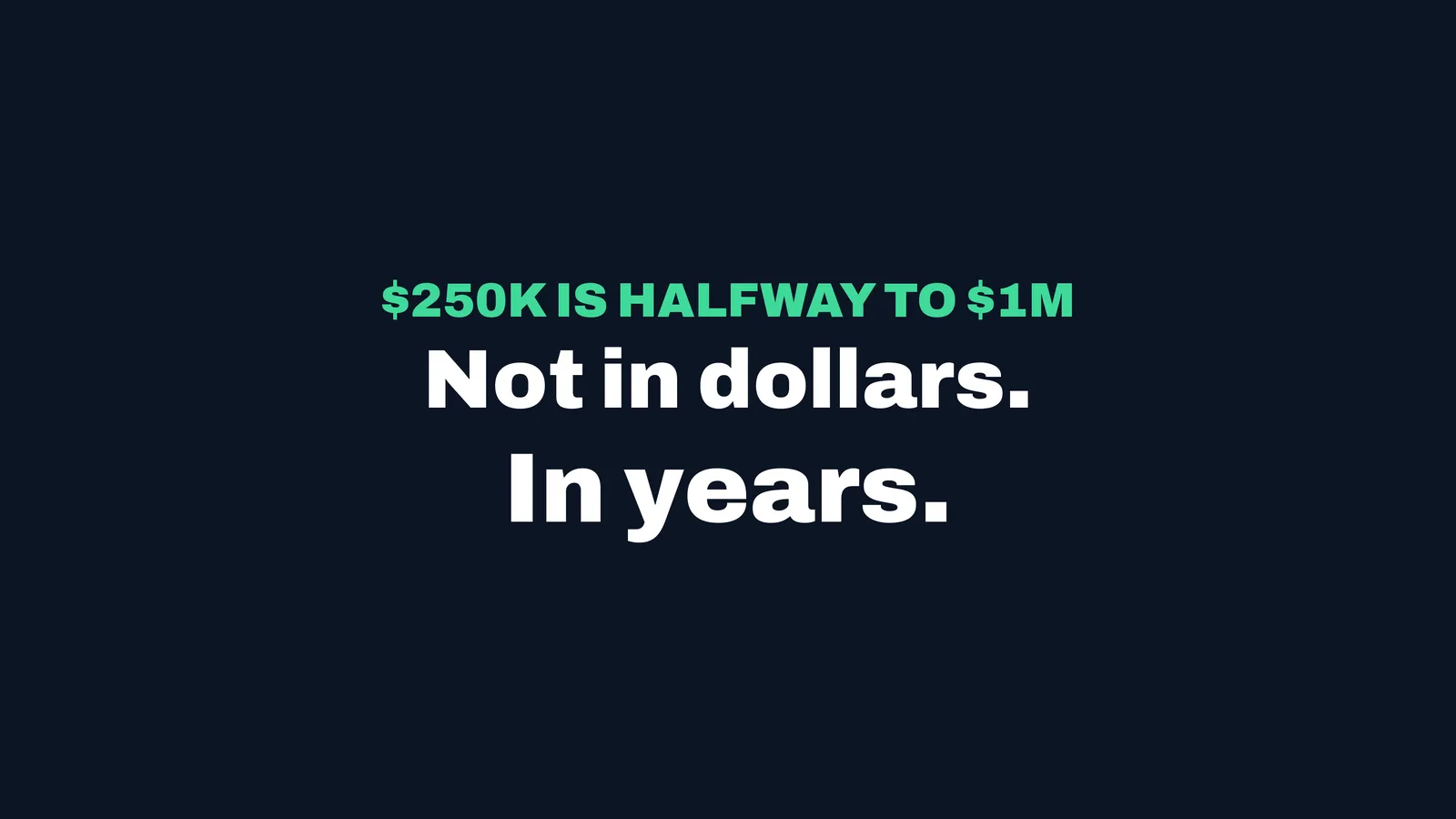
About 13 years to pass $250,000. About 13 more to pass $1 million. Same effort, same $1,000 a month, nearly three times the money. That’s why $250K is halfway to a million: not in dollars, in years.
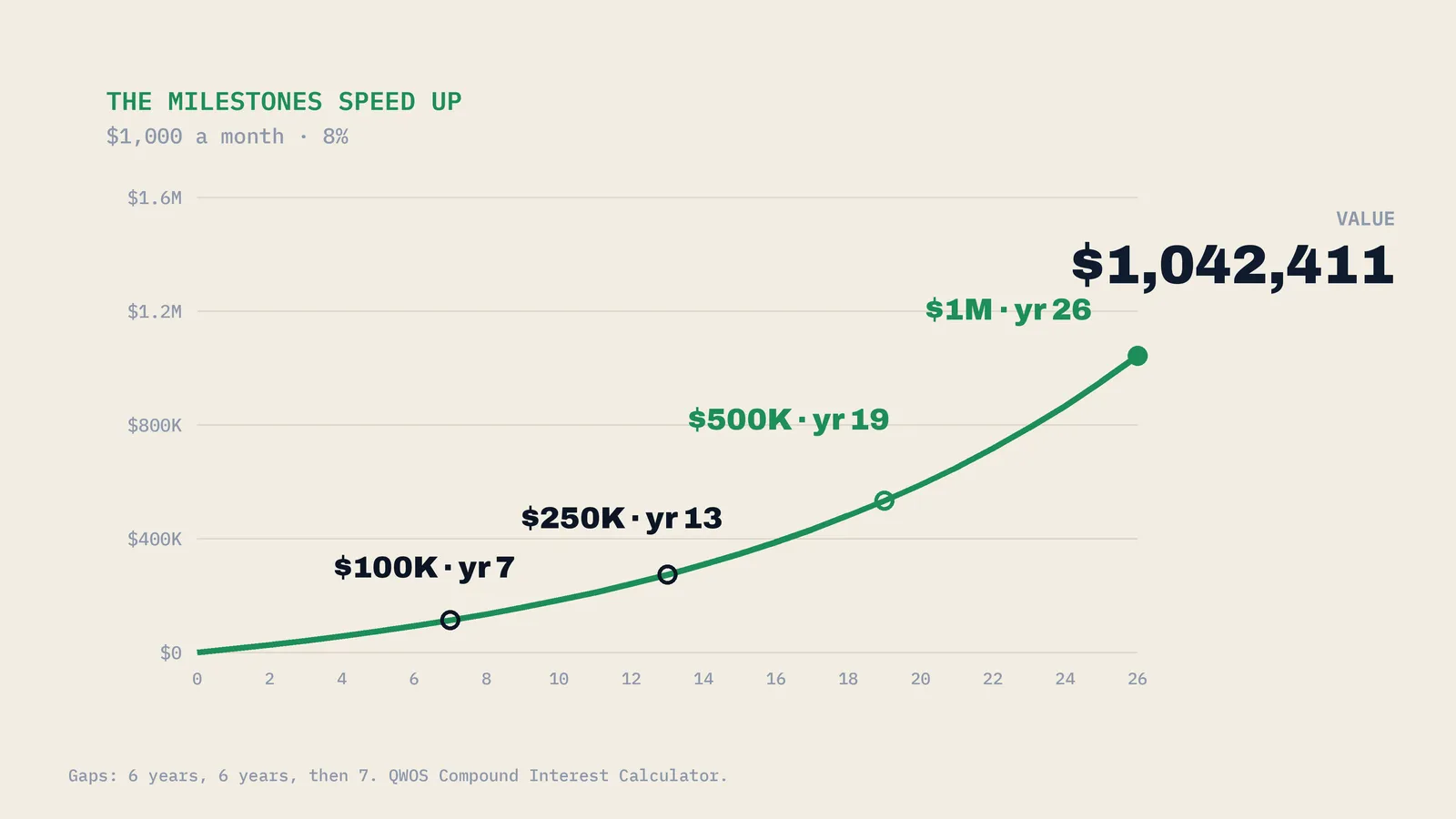
The milestones speed up
| Milestone | About when |
|---|---|
| $100,000 | year 7 |
| $250,000 | year 13 |
| $500,000 | year 19 |
| $1,000,000 | year 26 |
Each step is bigger than the last, but the gaps barely grow: 6 years, 6 years, then 7.
Why? $250,000 left alone for one year at 8% becomes $270,750, about $20,000 of growth. Marcus only puts in $12,000 a year. Past $250,000, the money out-works him nearly 1.75 to 1. Over 26 years, he puts in $312,000 and growth adds $730,411. Less than a third of the million is his own money.
Three ways to reach $250K faster
At $1,000 a month from 40, Marcus reaches a million at 66. Can he get there sooner?
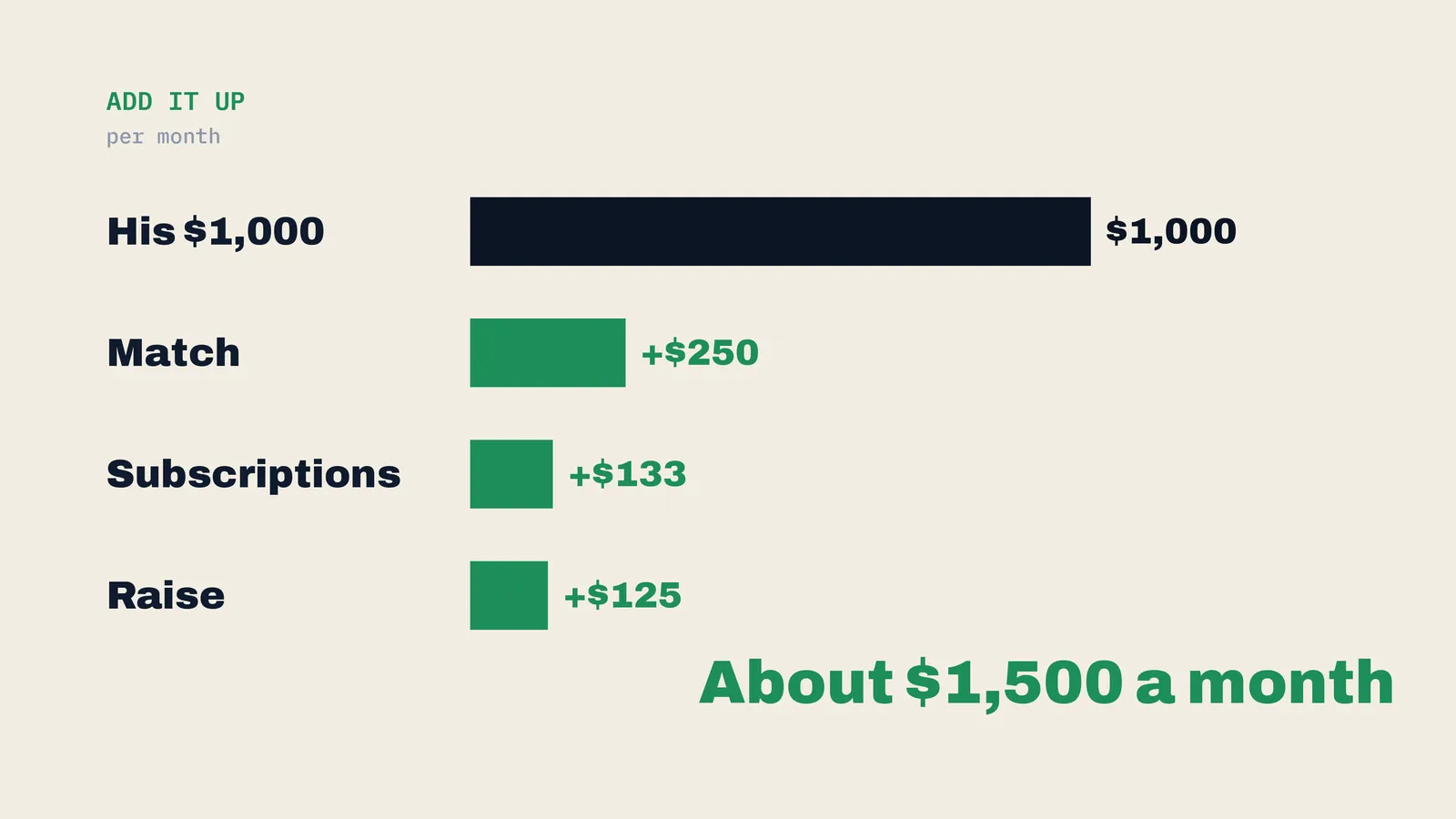
1. The match (Episode 4). He earns $100,000 and puts in 12%, which is his $1,000 a month. His employer adds 50 cents per dollar on the first 6% of salary: +$250 a month. At $1,250 a month, he passes $250,000 in 11 years ($263,225), two years sooner, and reaches $1,083,307 in 24 years. A million at 64, with no extra dollars of his own.
2. Forgotten subscriptions (Episode 19). In that survey, people guessed $86 a month and actually spent $219: off by about $133 a month. Cancel the forgotten ones and invest it.
3. Raises. A 3% raise on $100,000 is $3,000 a year, about $250 a month before tax. Send half to the account the day it starts: +$125 a month.
| Add it up | Per month |
|---|---|
| His contribution | $1,000 |
| Match | +$250 |
| Subscriptions | +$133 |
| Half the raise | +$125 |
| Total | about $1,500 |
At $1,500 a month and 8%, he passes $250,000 in about 10 years ($274,419) and crosses a million in 22: $1,075,182. That’s 62 instead of 66.
What if he stopped at $250K?
Back to $1,000 a month. Take the $272,920 he has after 13 years, add nothing, and let it sit 13 more years at 8%: $769,490. The contributions still matter, but the money he already has does most of the work.
The Honest Check: 6%
| At 6% | Result |
|---|---|
| $250,000, nothing added, 12 years | $512,688 |
| $1,000/mo, passes $250K | about 14 years ($262,305) |
| $1,000/mo, 30 years | $1,004,515 |
| $1,500/mo, 25 years | $1,039,491 |
It takes longer, but the shape is the same: the first $250,000 is the hard part.
What breaks the math
- Pulling money out early. Every dollar out stops doubling.
- Fees. Episode 8: a 1% fee quietly eats a big slice of the growth.
- Selling in a crash. Episode 11: the people who held on got the recovery.
And one more honest thing: at 3% inflation, $1,000,000 in 26 years will feel like $463,695 today. Still a lot of money, just not a million of today’s dollars.
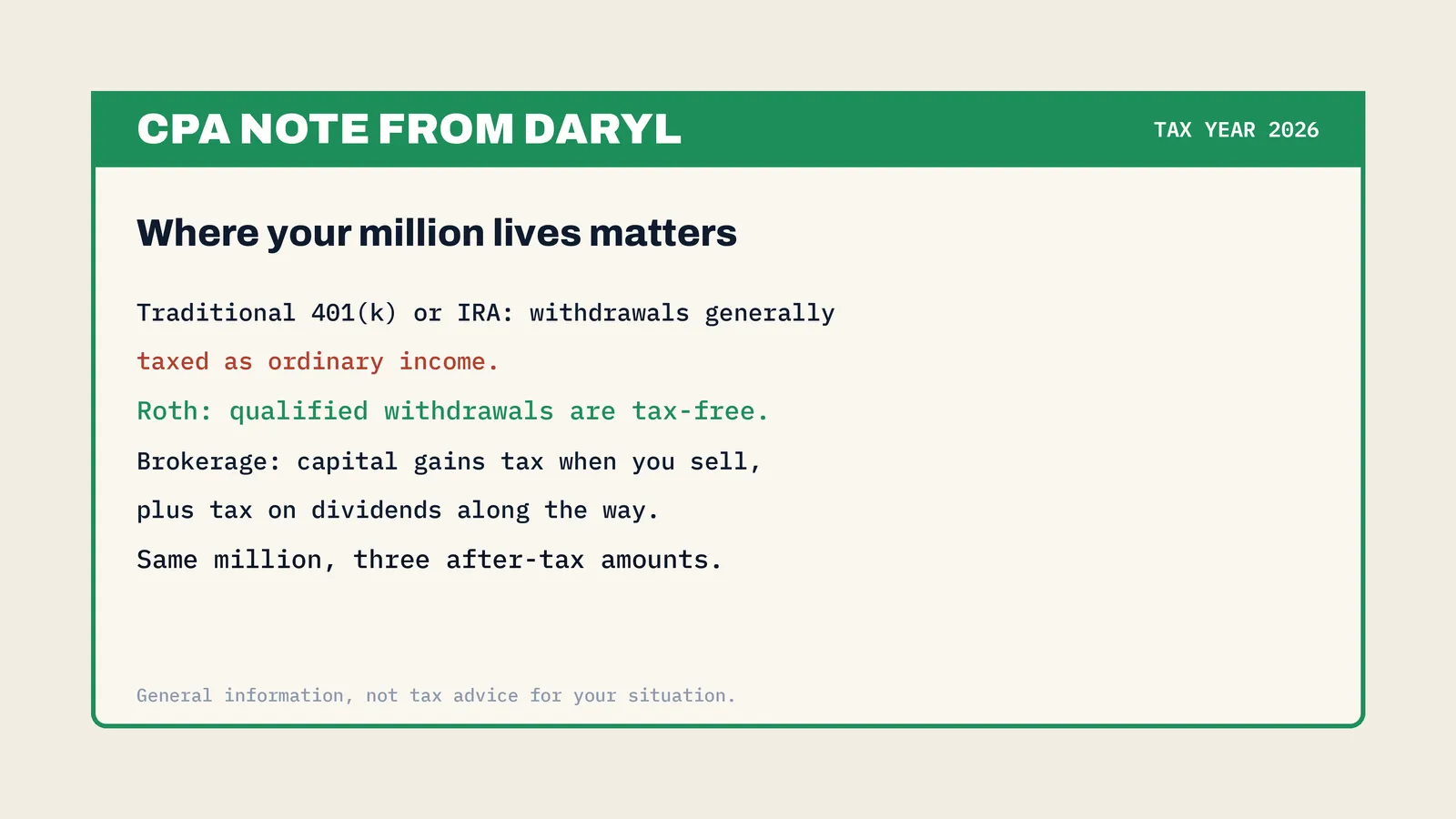
CPA Note from Daryl (tax year 2026)
Where your million lives matters.
- Traditional 401(k) or IRA: it usually went in before tax, so withdrawals are generally taxed as ordinary income.
- Roth: qualified withdrawals are tax-free.
- Regular brokerage account: you’ll generally owe capital gains tax on your gains when you sell, plus tax on dividends along the way.
Same million, three different after-tax amounts.
Next up: starting late makes the first $250,000 harder, but there’s help built into the rules. Why everything changes at 50, with catch-up contributions.
How the math works
Growth figures come from the QWOS Compound Interest Calculator (monthly compounding, monthly deposits, steady returns, no taxes or fees). The match comes from the QWOS 401(k) Calculator: $100,000 salary, 12% contribution, 50% match up to 6% of salary. Inflation comes from the QWOS Inflation Calculator: $1,000,000, 26 years, 3%. Subscription figures: C+R Research survey, 2022. Rule of 72 is an approximation.
Education, not financial or tax advice. Hypothetical returns; real results vary and losses happen.