



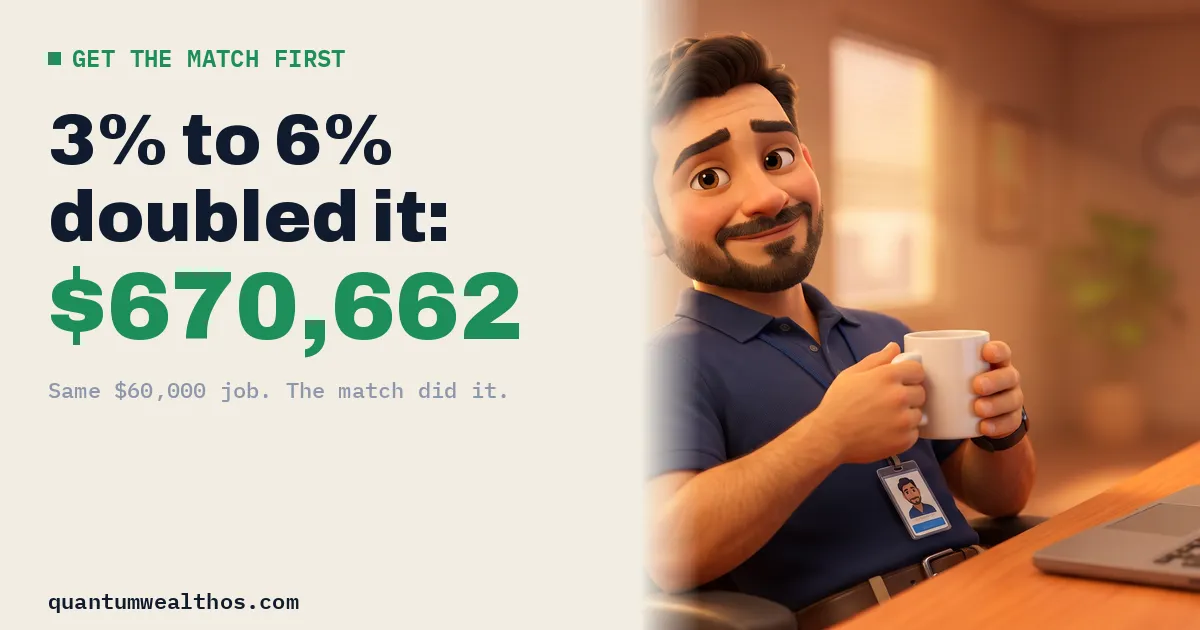
Marcus is 35. He makes $60,000 a year, and there’s a raise sitting in his benefits page that he almost skipped. It’s called the 401(k) match.
When he signed up, he picked 3%. It felt safe. Here’s what that one click costs him.
How a match works
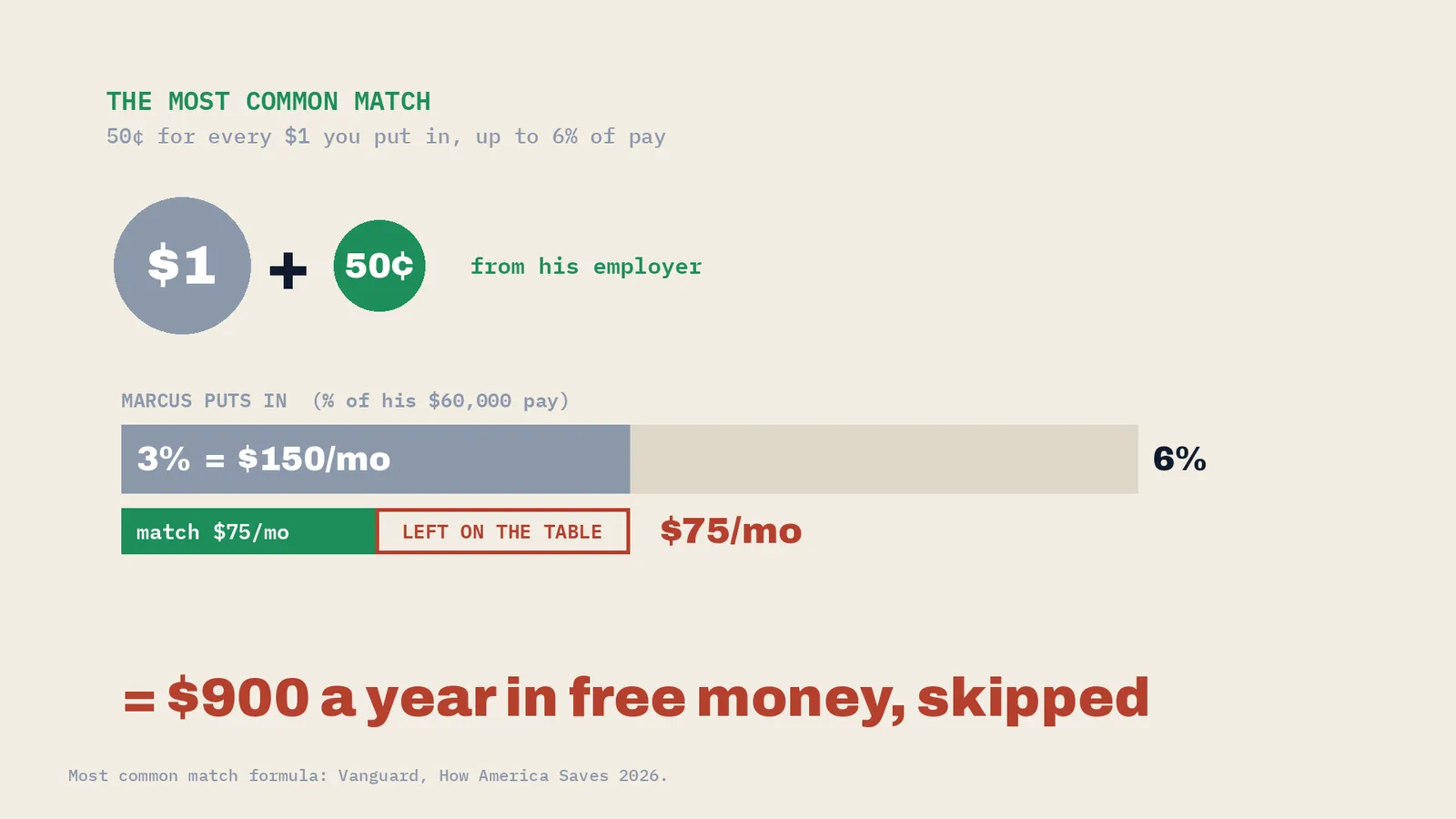
The most common match is 50 cents for every dollar you put in, up to 6% of your pay.
| Marcus contributes | He puts in | His employer adds |
|---|---|---|
| 3% of $60,000 | $150 a month | $75 a month |
| 6% of $60,000 | $300 a month | $150 a month |
At 3%, he’s leaving $75 a month on the table. That’s $900 a year of free money, skipped.
The run: 3% vs 6%
401(k) calculator, $0 to start, 8% a year from 35 to 65:
| He puts in | Employer adds | Balance at 65 | |
|---|---|---|---|
| 3% | $54,000 | $27,000 | $335,331 |
| 6% | $108,000 | $54,000 | $670,662 |
It doubled. His paycheck gives up another $150 a month, and his employer adds another $75 on top.
The match is a 50% return on day one
Every dollar Marcus puts in, up to 6%, becomes $1.50 the day it lands. That’s a 50% return before the market does anything. No index fund promises that.
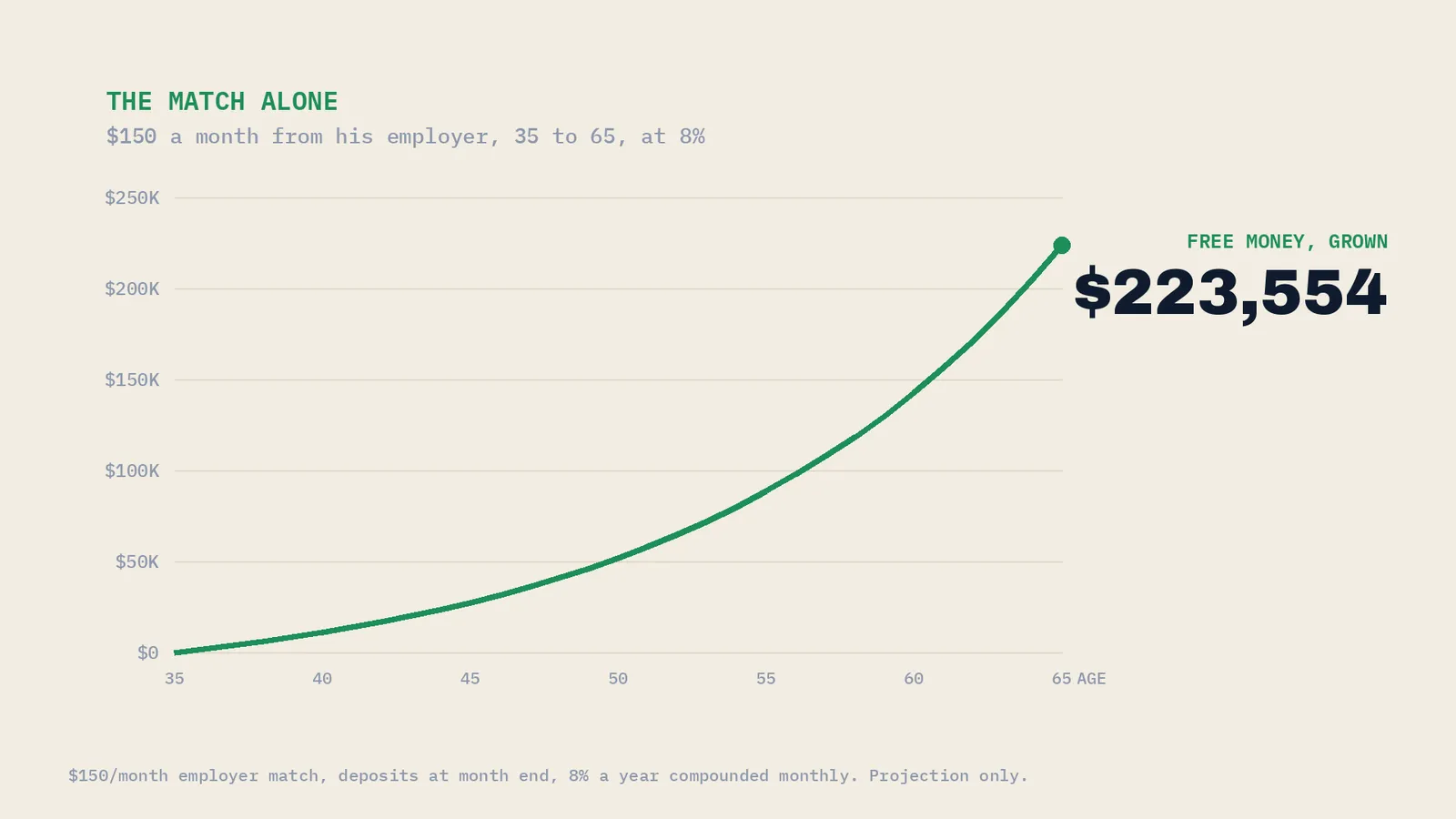
Over 30 years, the match by itself, $150 a month, could grow to $223,554 at 8%.
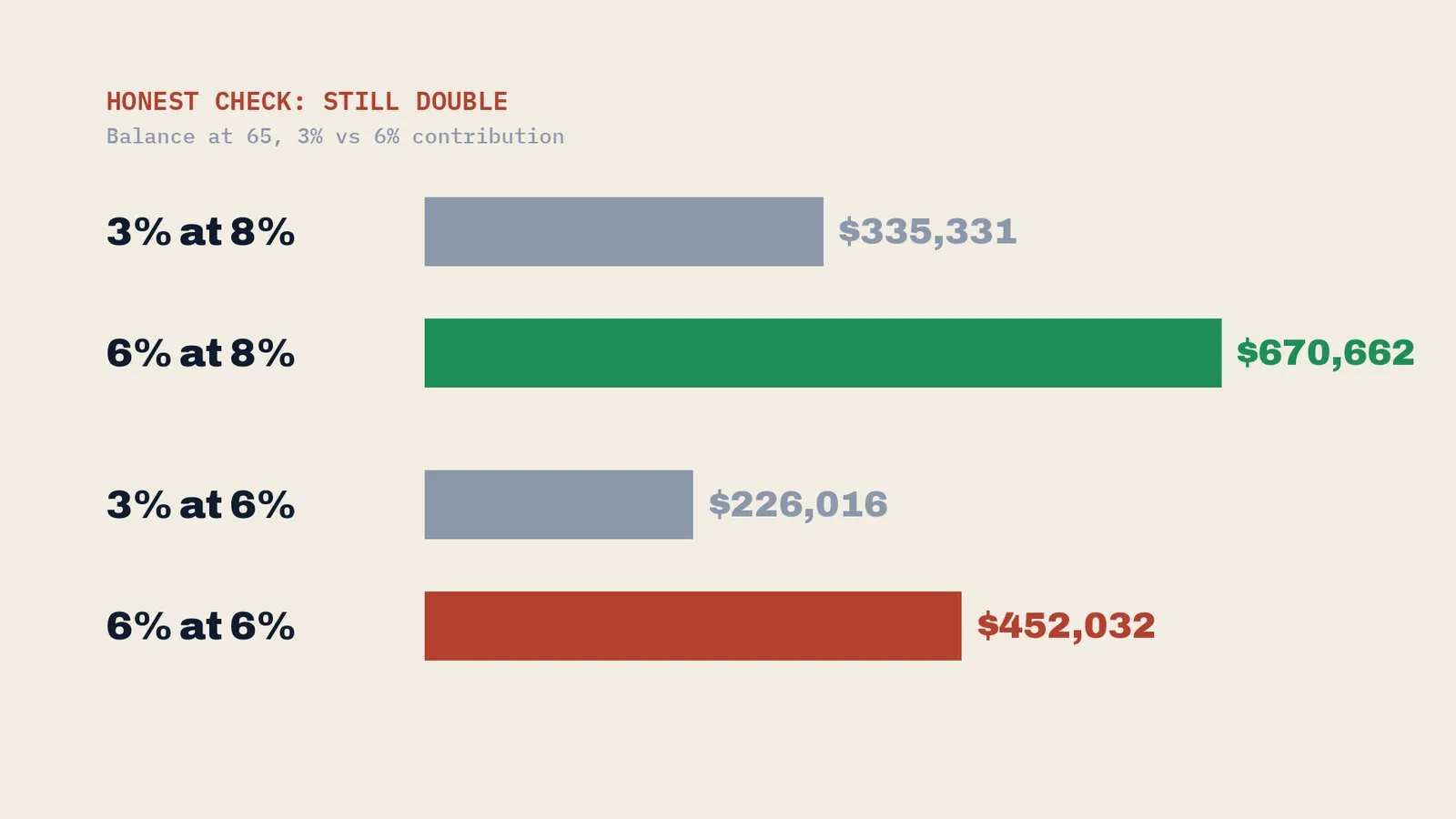
The Honest Check: what if it’s only 6%?
| Balance at 65 (6%) | |
|---|---|
| 3% contribution | $226,016 |
| 6% contribution | $452,032 |
Still double. The match doesn’t depend on the market: that 50 cents shows up either way.
CPA Note from Daryl (tax year 2026). A traditional 401(k) contribution comes out before federal income tax. In the 12% bracket, Marcus’s extra $1,800 a year cuts his federal tax by about $216. Social Security and Medicare tax still apply. General information, not tax advice for your situation.
One catch: vesting
About half of plans let you keep the match right away. Others make you stay a few years before it’s yours. Check your plan’s vesting schedule before you change jobs.
Step one of the order
After a starter emergency fund, get the full match. Every time. Marcus changed one number, and his future self just got a raise.
Next up: where should the rest of your money go, a 401(k), a traditional IRA, or a Roth? Which bucket first.
How the math works
Salary and contribution rate held flat, contributions monthly, 8% a year compounded monthly (6% for the Honest Check). Every balance matches the QWOS 401(k) Calculator below; the match-alone figure uses the QWOS Compound Interest Calculator ($150 a month for 30 years).
Education, not financial or tax advice. Projections assume steady returns; real returns vary and can be negative.
Sources: Vanguard, How America Saves 2026 (most common match formula; 49% of plans vest the match immediately) · IRS: 2026 401(k) limit $24,500 · AARP: 2026 tax brackets