



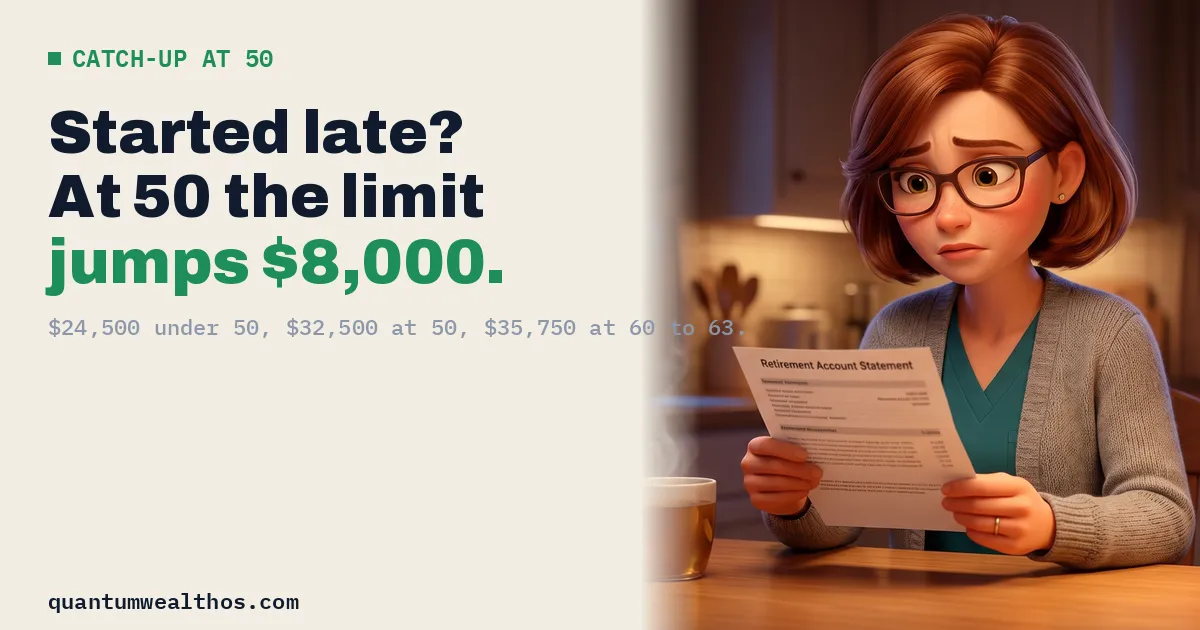
Denise is 45. She has $85,000 in her 401(k), and she keeps hearing she should have a lot more by now. She feels late. The good news: at 50, the rules change in her favor.
Where she stands
Denise earns $120,000 a year. She puts in 10%, and her employer adds 50 cents per dollar, up to 6% of her pay.
| 401(k) calculator, 8% a year, 45 to 67 | |
|---|---|
| Her contributions | $1,000 a month |
| Employer match | +$300 a month |
| Balance at 67 | $1,423,005 |
That’s not hopeless. That’s a plan. But she has room to do more.
The 2026 limits
| Age | 401(k) limit |
|---|---|
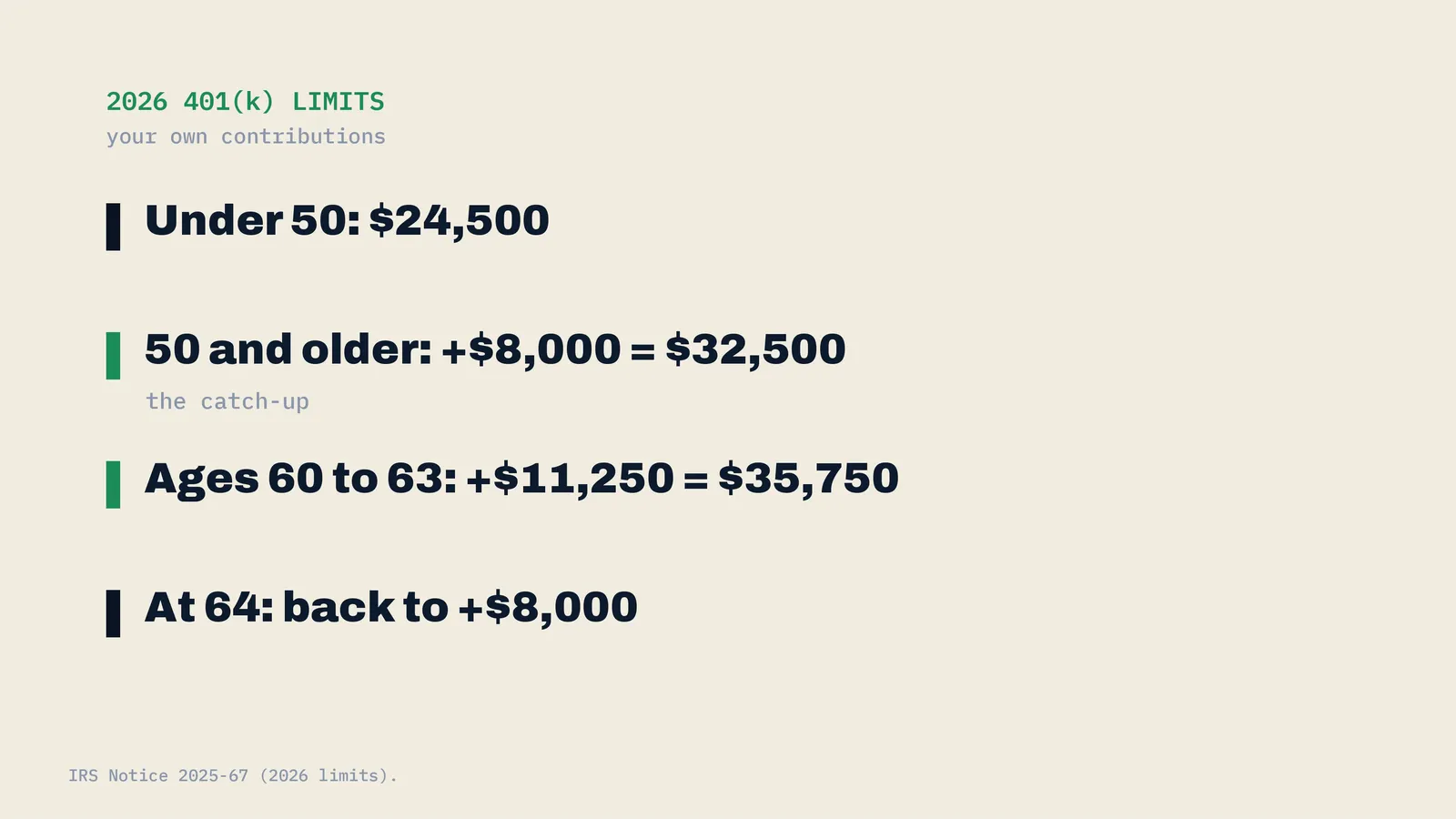
| Under 50 | $24,500 |
| 50 and older | $32,500 (+$8,000 catch-up) |
| 60 to 63 | $35,750 (+$11,250 catch-up) |
| 64 and older | back to $32,500 |
IRAs get a catch-up too: $7,500, plus $1,100 at 50.
Most people never get near these limits. In Vanguard’s How America Saves 2026, only 14% of participants saved the maximum in 2025, and in plans that offer catch-ups, 17% of people 50 and older used them. For most incomes, using them means saving more than 20% of pay.
What each move is worth (8%)
| Move | Balance at 67 |
|---|---|
| 10% today | $1,423,005 |
| 12% today | $1,566,362 (about $143,000 more) |
| 25% (calculator max; capped at $24,500 until 50, then her full $30,000) | $2,367,566, with $632,500 of her own money |
The catch-up by itself, for someone already at the regular limit: $8,000 a year ($666.67 a month) from 50 to 67 grows to $287,866 (using the age-50 catch-up only; ages 60 to 63 allow $11,250). Half of it, $333.33 a month, grows to $143,931.

Finding the money
- When a big bill ends, like a car payment or daycare, send that same amount to the 401(k).
- Put part of every raise in, like Marcus did in Episode 27.
- If you have an HSA (Episode 20), it gets its own $1,000 catch-up at 55.
- The year you turn 50, check your plan. You may have to raise your contribution yourself.
The bigger 60-to-63 limit doesn’t change anything for Denise: her 25% is $30,000, already under the $32,500 limit.
The Honest Check: 6%
| At 6% | Result |
|---|---|
| 10% plan at 67 | $1,027,240 |
| All-in plan at 67 | $1,758,122 |
| Full catch-up alone, 17 years | $235,489 |
Two more honest things. These are future dollars: at 3% inflation, $1,423,005 in 22 years feels like $742,656 today. And the calculator holds the limits at 2026 levels; the IRS usually raises them with inflation.
CPA Note from Daryl (tax year 2026)
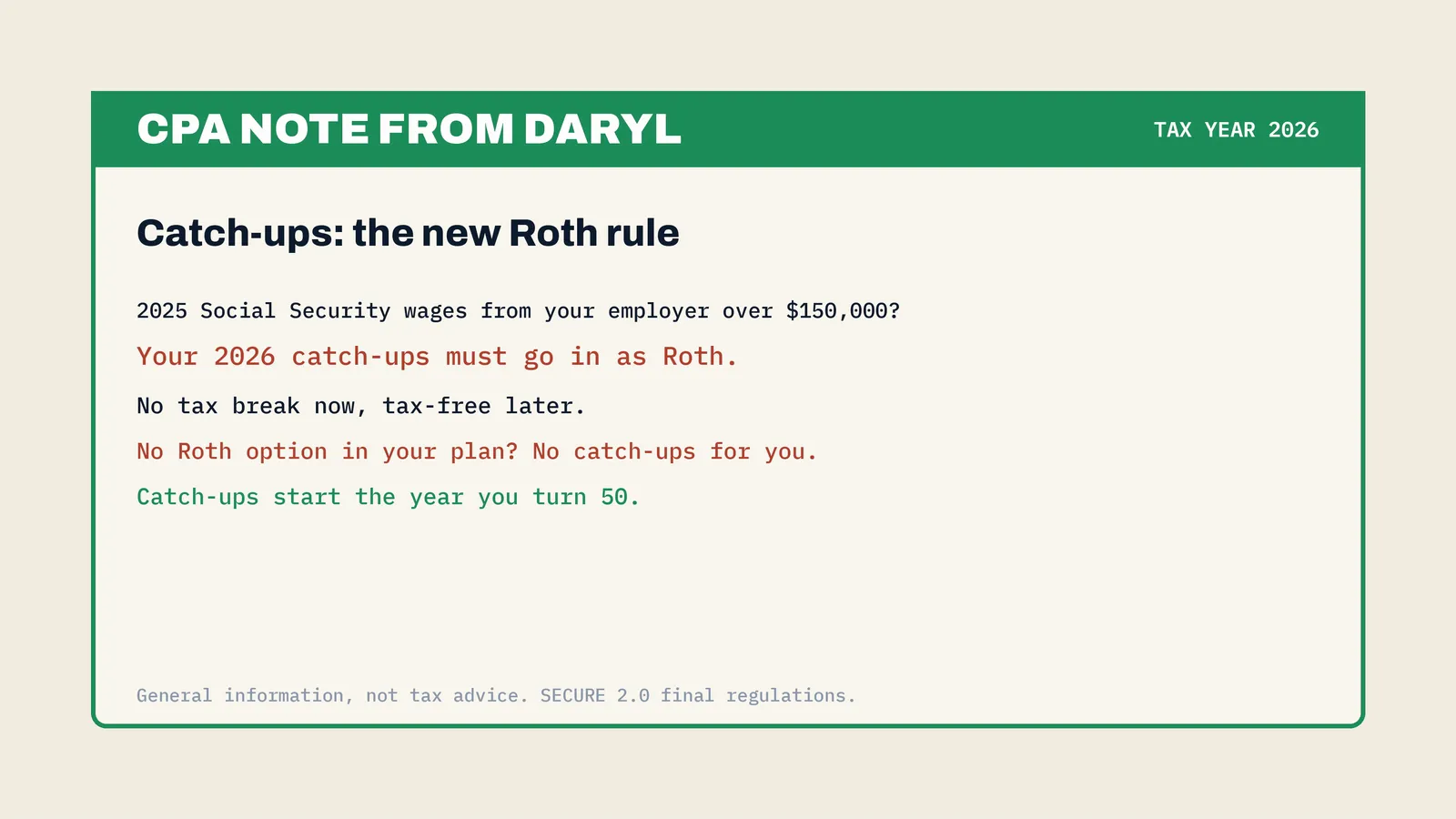
- New Roth catch-up rule: if your 2025 Social Security (FICA) wages from your employer were over $150,000, your 2026 catch-up contributions must go in as Roth. No tax break now, tax-free later.
- If you’re in that group and your plan has no Roth option, you can’t make catch-ups at all.
- Catch-ups start in the year you turn 50, even before your birthday.
Next up: 5 signs you’re doing better financially than you think.
How the math works
401(k) figures: QWOS 401(k) Calculator, $85,000 balance, $120,000 salary, 50% match up to 6%, age 45, 22 years to retirement, 8% (or 6%). The calculator applies each year’s age-based limit, holds limits at 2026 dollars, and assumes monthly contributions and compounding. Catch-up-alone figures: QWOS Compound Interest Calculator, $666.67 or $333.33 a month for 17 years. Inflation: QWOS Inflation Calculator, 3%. Limits: IRS Notice 2025-67. Participation data: Vanguard, How America Saves 2026. Roth catch-up rule: SECURE 2.0 final regulations.
Education, not financial or tax advice. Hypothetical returns; real results vary and losses happen.