



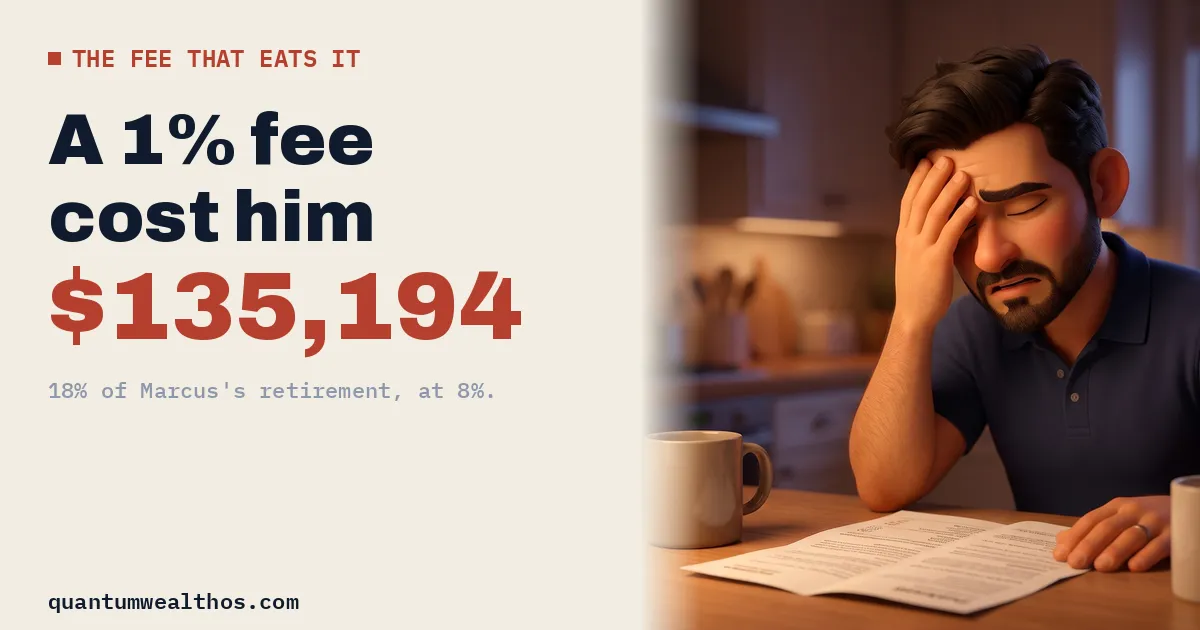
Marcus’s $500 a month from Episode 1 grows to $745,180 by 65. At least, it does with no fees. But every fund charges a fee, and so does every advisor. Here’s how much.
How fees work
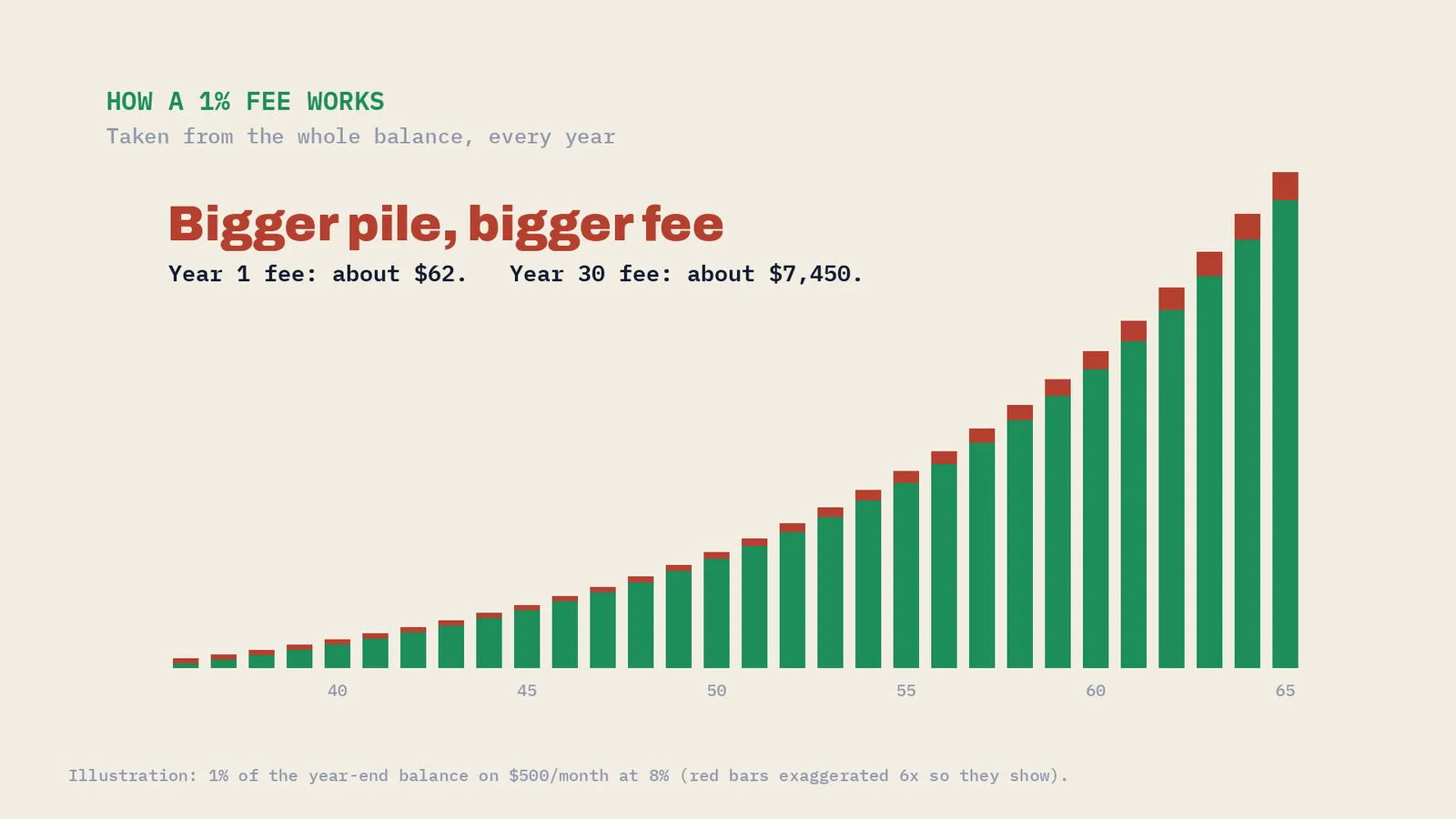
Fees are a percentage of your balance, every year. So as your money grows, the fee grows with it. A 1% fee doesn’t take 1% once. It takes 1% every year, for 30 years, from a bigger pile each time.
The run: four fees, same $500 a month
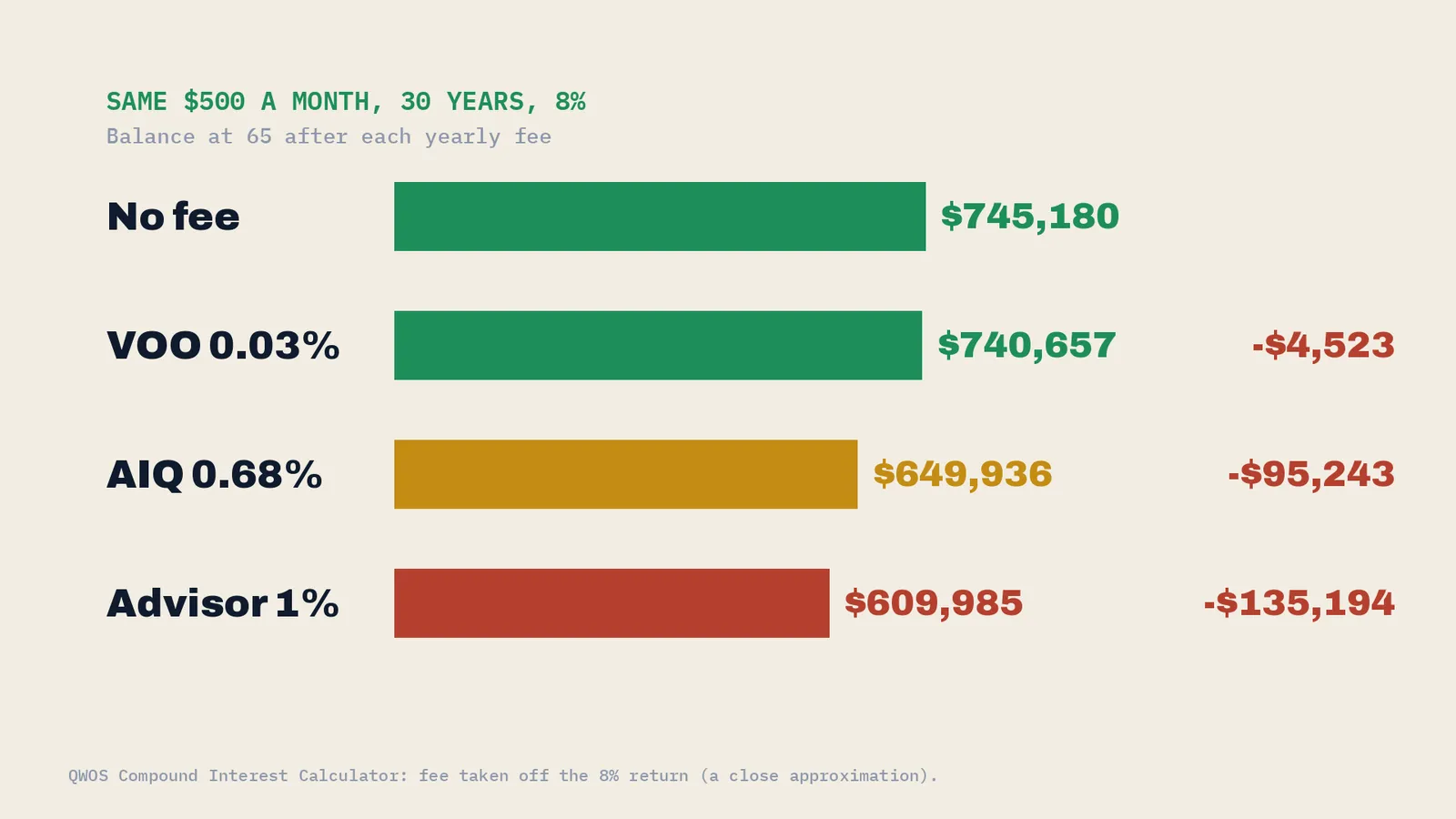
QWOS Compound Interest Calculator, $500 a month for 30 years, with each fee taken off the 8% return:
| Fee | Rate | Balance at 65 | Fees cost him |
|---|---|---|---|
| None | 8% | $745,180 | — |
| VOO, 0.03% | 7.97% | $740,657 | $4,523 |
| AIQ, 0.68% | 7.32% | $649,936 | $95,243 |
| Advisor, 1% | 7% | $609,985 | $135,194 (18%) |
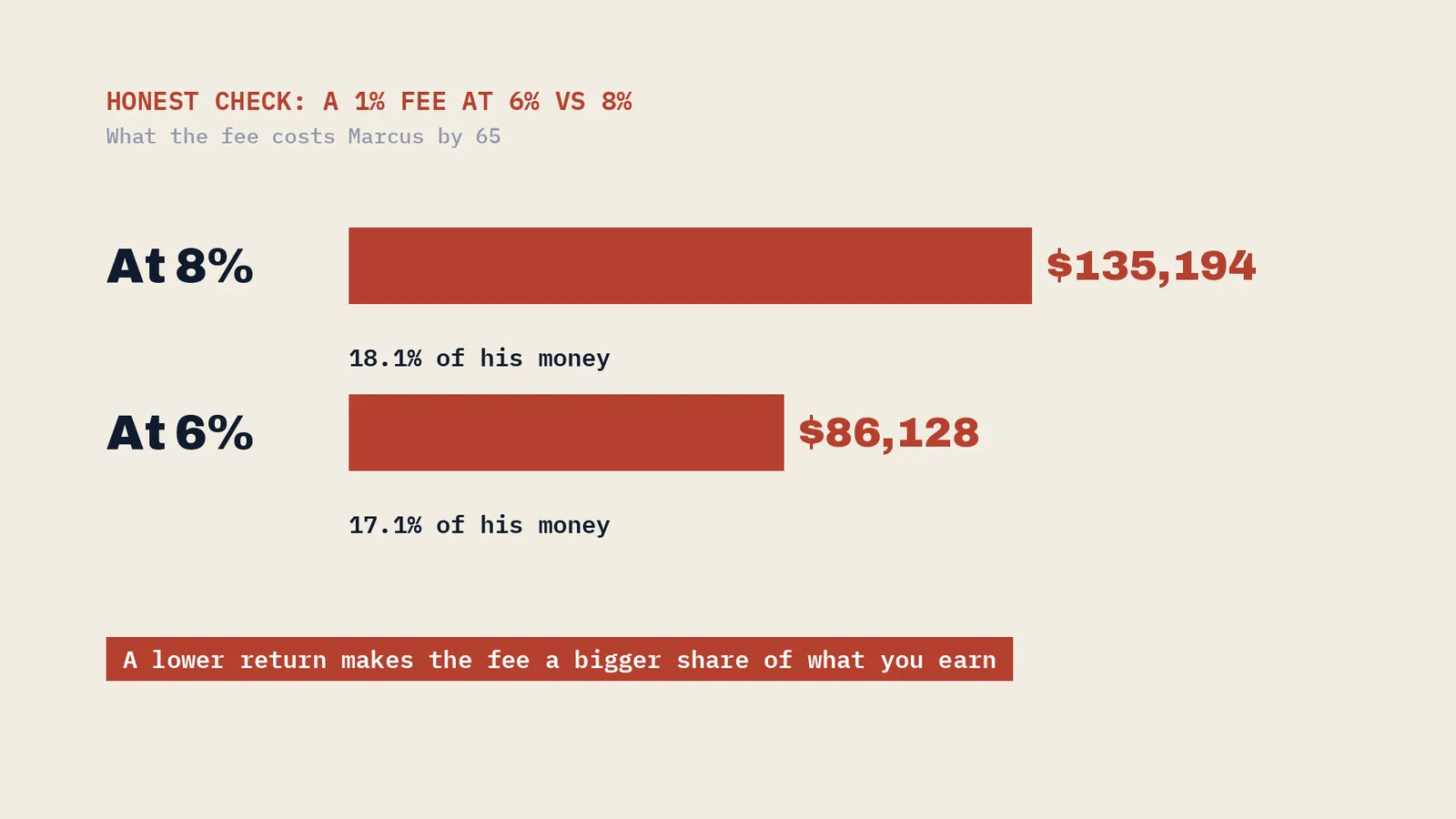
The Honest Check: what if the market only gives 6%?
A 1% fee then takes fewer dollars, $86,128 instead of $135,194, but it’s still 17% of his money ($416,129 vs $502,258). A lower return doesn’t make the fee smaller. It makes it a bigger share of what you earn.
Is a 1% advisor ever worth it?
Sometimes. A good one can stop you from selling in a panic, or save you real money on taxes. 1% is a common price. Just know what it adds up to: on Marcus’s numbers, about $135,000.
Where to find your fees
Your fund’s fee is called the expense ratio, and it’s on every fund’s page. An advisor’s fee is in your agreement, usually a percent of what they manage. Check both. Then ask: what am I getting for it?
Next up: Denise is 45 with nothing saved. Is it too late?
How the math works
Deposits at the end of each month, compounded monthly. Fees are modeled by subtracting them from the yearly return (8% − 1% = 7%), a close approximation of how a percentage fee works. Every balance matches the QWOS Compound Interest Calculator below.
Education, not financial advice. Hypothetical returns; real results vary and losses happen.
Sources: Kitces: typical advisory fees · Global X: AIQ, 0.68% · Vanguard: VOO, 0.03%