



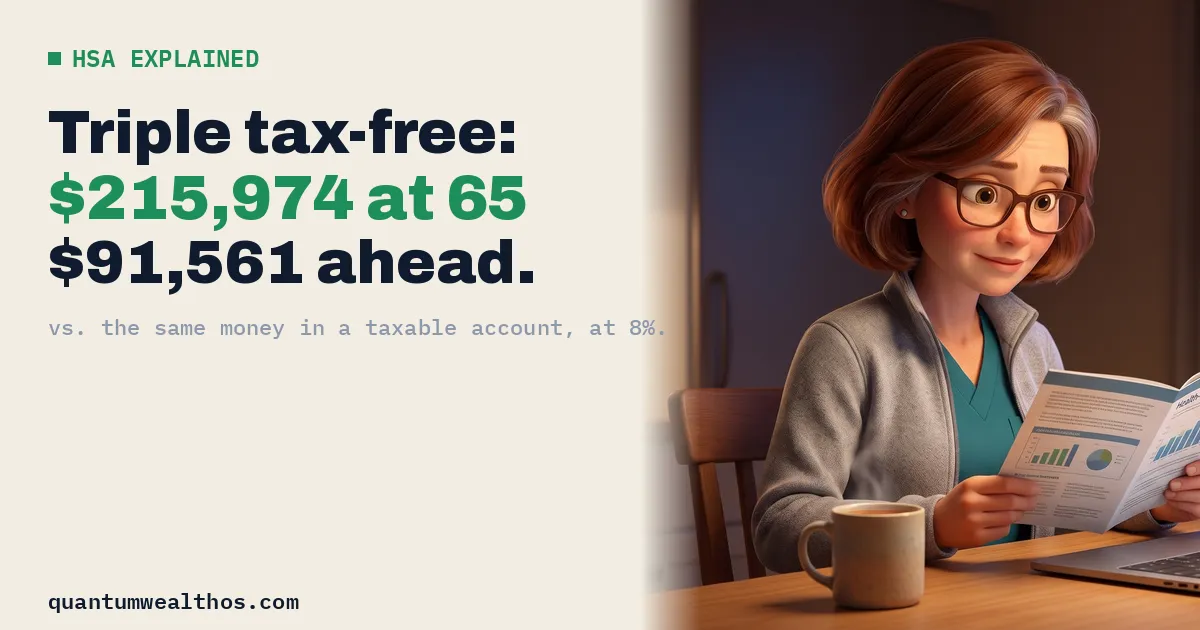
Denise is 45, and it’s open enrollment. Her job offers a high-deductible health plan with an HSA. She’s always skipped it. This year she asked: what is she missing?
Three tax breaks in one account
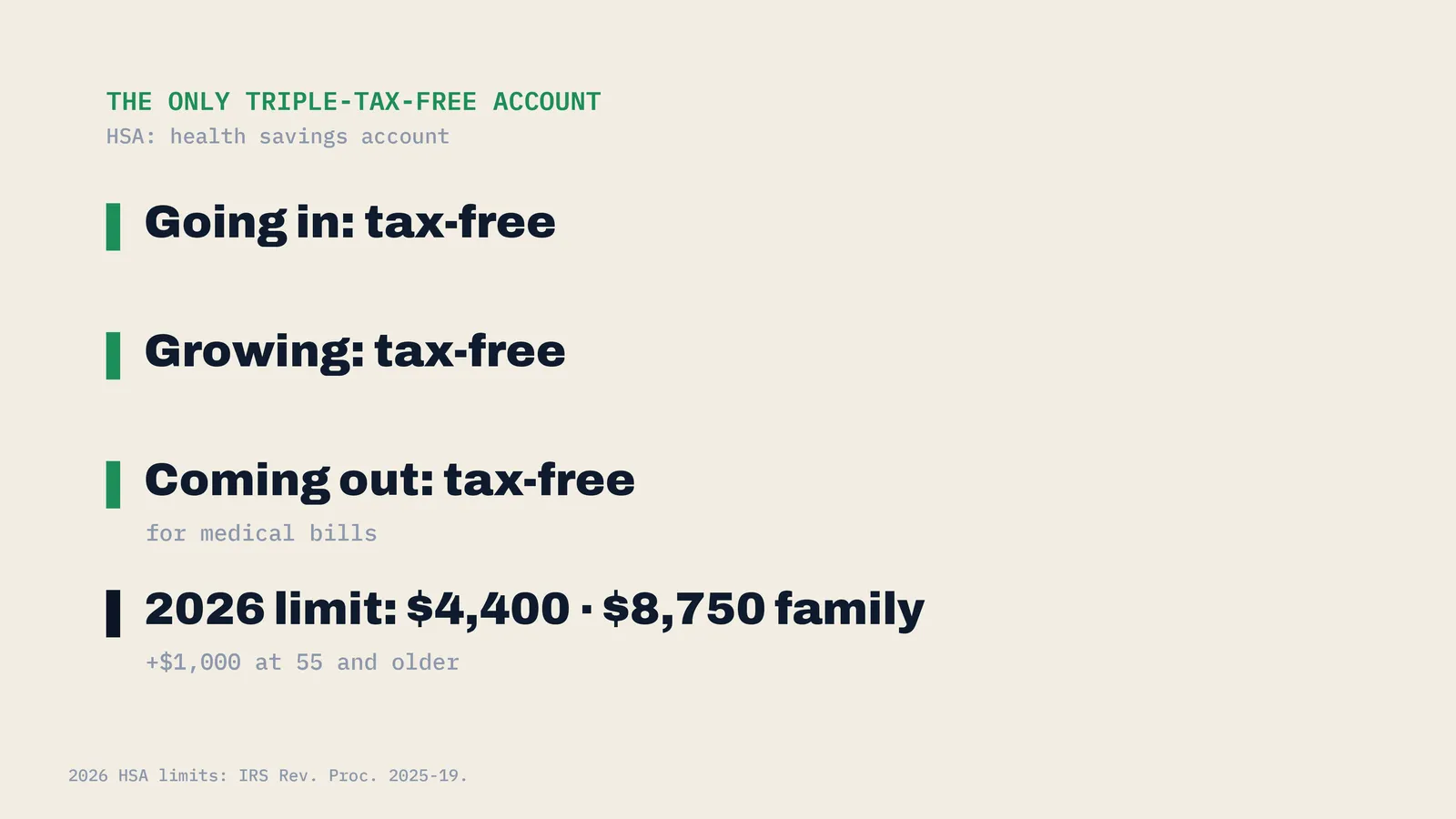
An HSA (health savings account) is the only account with three tax breaks:
- Going in: contributions lower your taxable income.
- Growing: no tax on the growth.
- Coming out: no tax on withdrawals for qualified medical bills.
The 2026 limit is $4,400 for self-only coverage, $8,750 for family coverage, plus $1,000 more at 55 or older.
What it saves Denise every year
| Denise’s inputs | |
|---|---|
| Contribution | $4,400 a year, self-only |
| Federal bracket | 22% |
| State tax | 5% |
| Through payroll | Yes (also skips the 7.65% Social Security and Medicare tax) |
| Tax saved per year | $1,525 (34.65% of $4,400) |
Invest it, don’t just spend it
An HSA can be invested. $4,400 a year from 45 to 65 at 8%:
| At 8% | |
|---|---|
| Put in | $88,000 |
| Invested HSA at 65 | $215,974 |
| Same money in a regular taxable account, after tax | $124,413 |
| HSA ahead by | $91,561 |
The taxable comparison taxes the money going in at her combined rate, then taxes the gains when sold at 65.
The catch: let it grow
That only works if she pays medical bills from her pocket. If she spends $1,500 a year from the HSA instead, she ends up with $142,347 at 65.
The trick: keep the receipts. She can pay herself back from the HSA, tax-free, years later, for medical bills from after she opened it.
The Honest Check: 6%
| At 6% | At 65 |
|---|---|
| Invested HSA | $169,415 |
| Taxable account, after tax | $100,072 |
| HSA ahead by | $69,343 |
The fine print
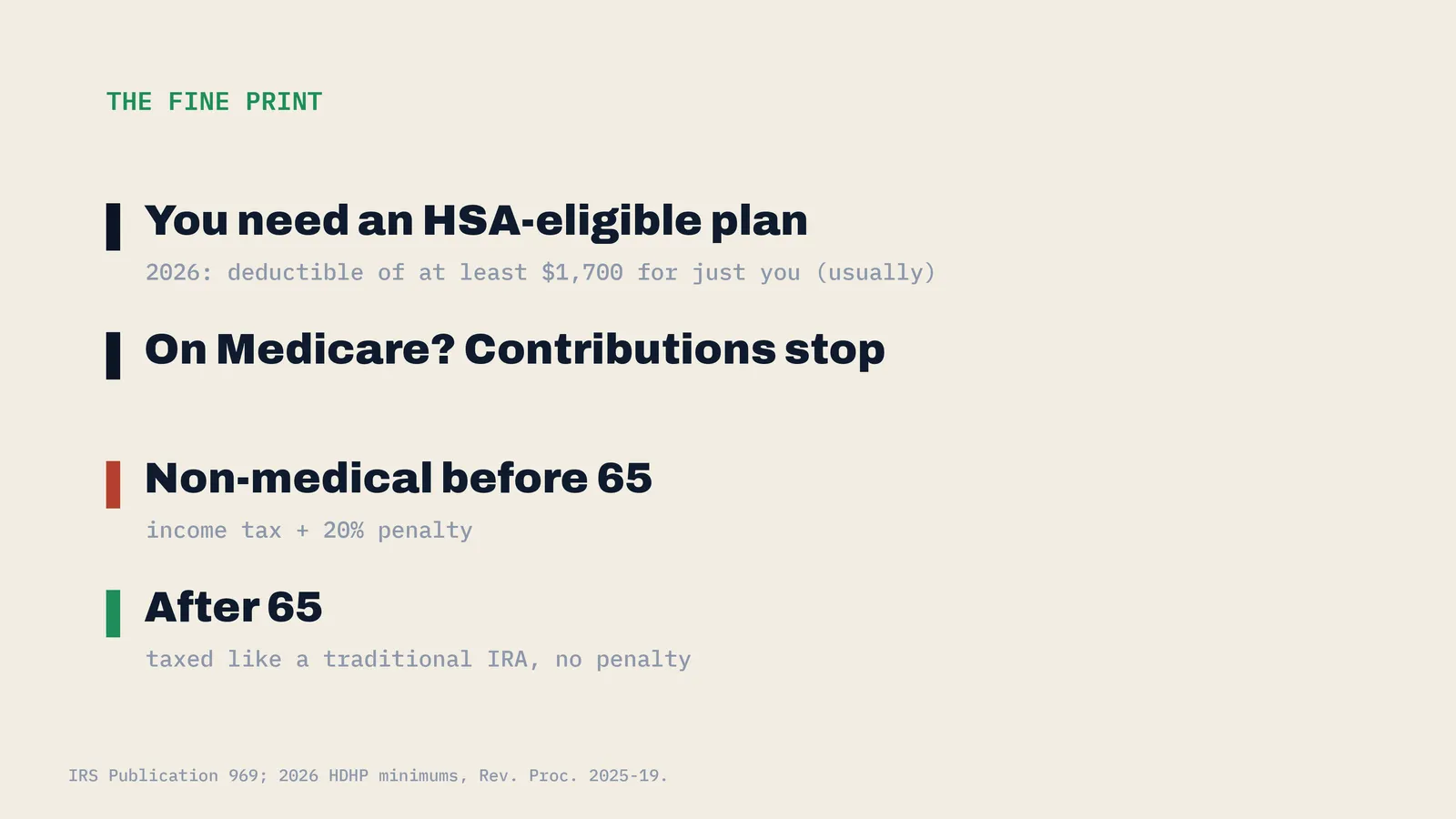
- You need an HSA-eligible health plan. In 2026 that usually means a deductible of at least $1,700 for self-only coverage.
- Once you’re on Medicare, contributions stop.
- Take money out for something other than medical bills before 65, and you owe income tax plus a 20% penalty.
- After 65, non-medical withdrawals are taxed like a traditional IRA, with no penalty.
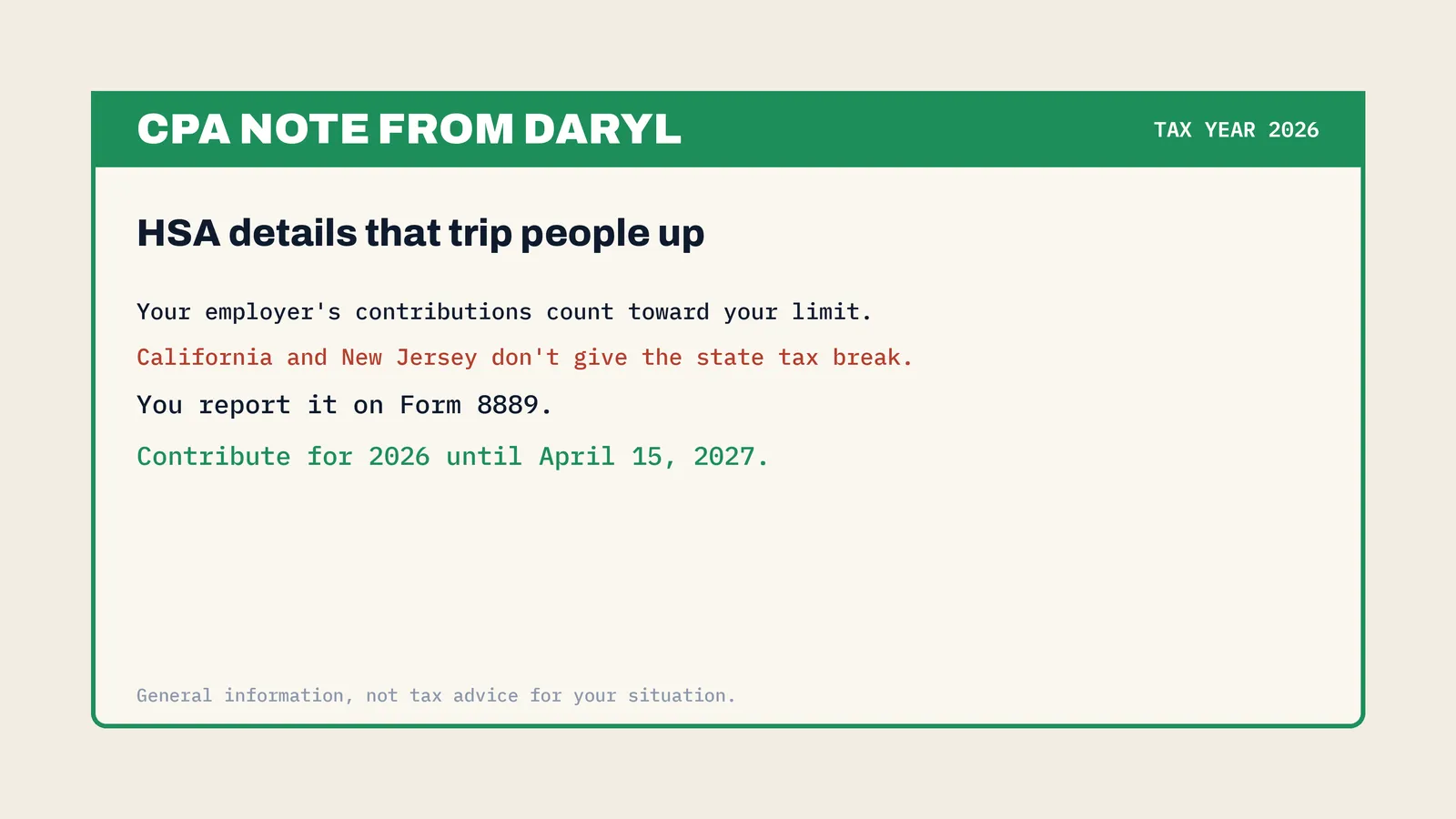
CPA Note from Daryl (tax year 2026)
- Your employer’s contributions count toward your limit.
- California and New Jersey don’t give the state tax break.
- You report HSA contributions and withdrawals on Form 8889.
- You have until April 15, 2027 to contribute for 2026.
Next up: an HSA can be invested, but in what? Target-date funds: is one fund enough?
How the math works
All figures come from the QWOS HSA Calculator: self-only, age 45, $0 balance, $4,400 a year, $0 employer, $1,500 of medical bills a year, 22% federal, 5% state, payroll contributions on, 8% or 6% a year to 65. The calculator assumes contributions stay at today’s amount (no catch-up added at 55), monthly deposits, and steady returns; the taxable comparison taxes gains at 15% federal plus the state rate when sold at 65. 2026 HSA limits and HDHP minimums: IRS Rev. Proc. 2025-19.
Education, not financial or tax advice. Hypothetical returns; real results vary and losses happen.