



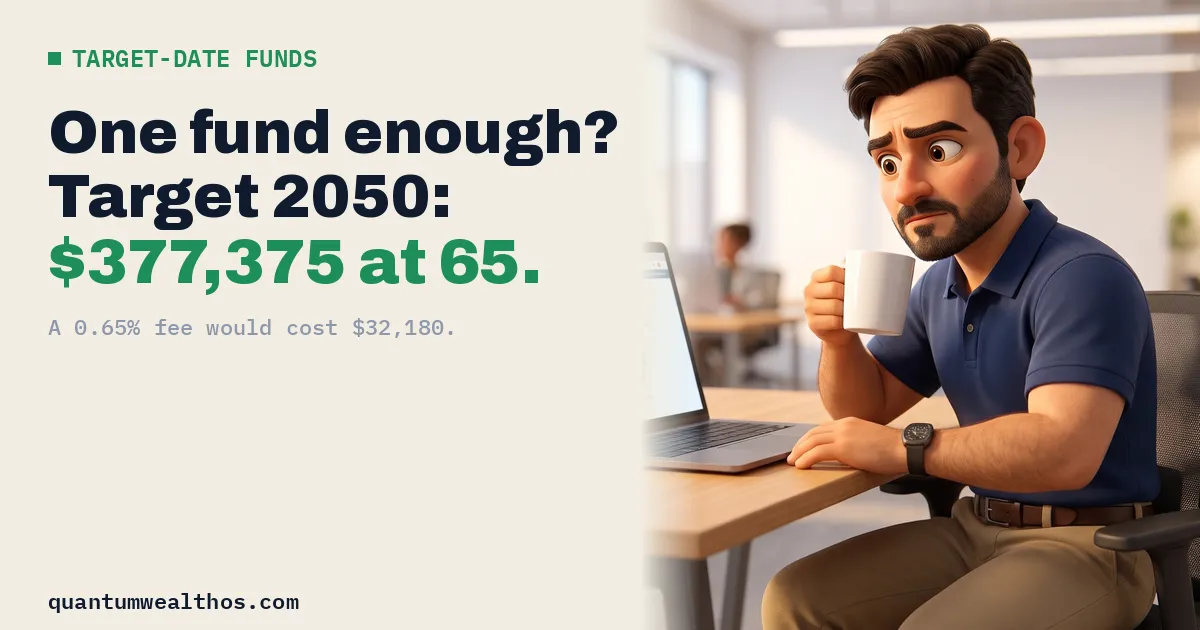
Marcus is 40, and his new job’s 401(k) put him in one fund by default: Target 2050. No stocks to pick, no mix to manage. Is one fund really enough?
One fund, a whole portfolio
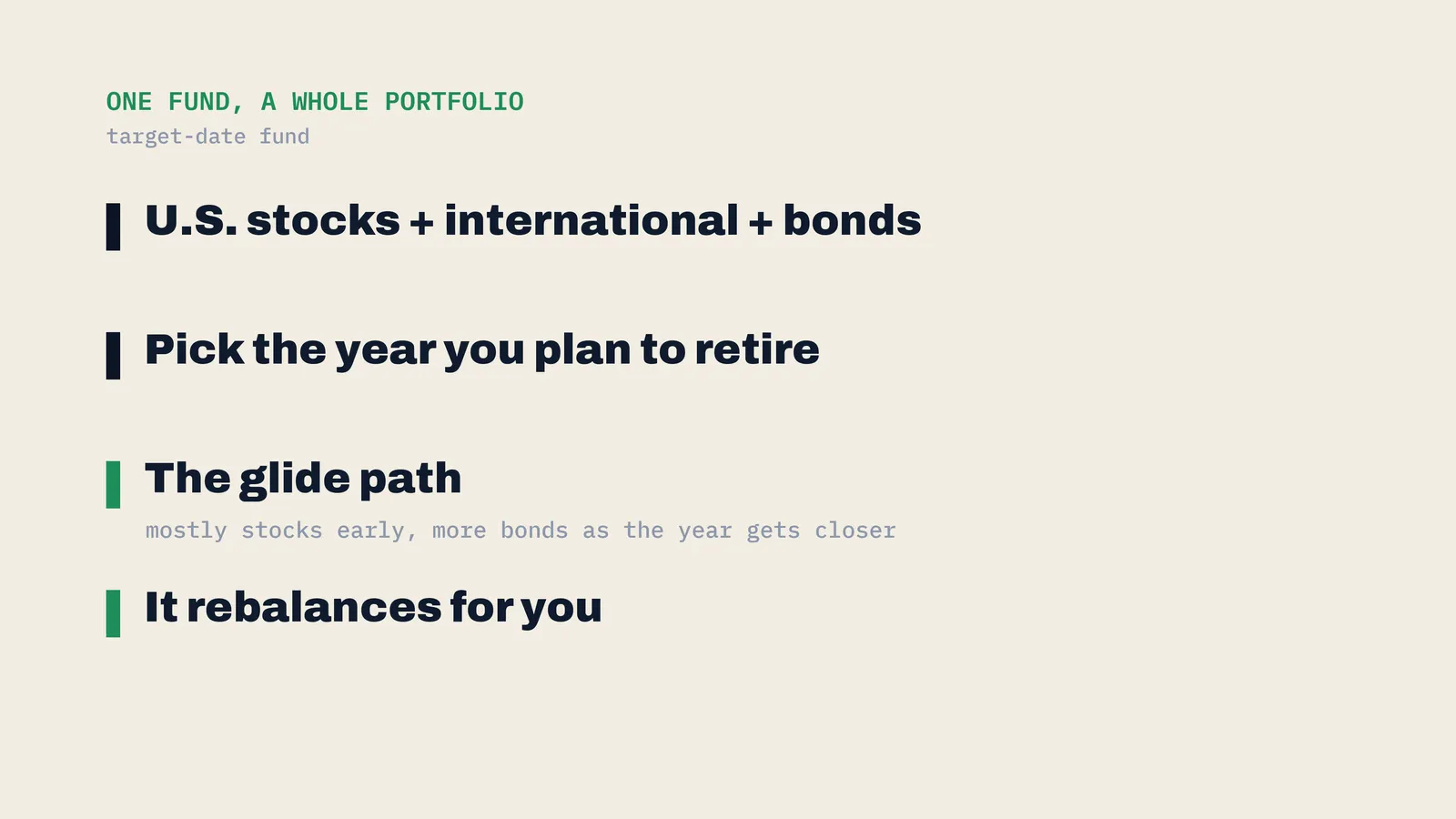
A target-date fund holds U.S. stocks, international stocks, and bonds. You pick the year you plan to retire. Early on, it’s mostly stocks. As that year gets closer, it shifts toward bonds. That schedule is the glide path, and the fund rebalances along the way.
Marcus’s fund
Marcus plans to retire at 65, in 2051. The calculator points him to Target 2050.
| Glide path (Vanguard-style) | Stocks |
|---|---|
| Today | about 90% |
| At 65 | about 50% |
| Seven years after that | about 30% |
What it grows to
$500 a month for 25 years, stocks at 8% and bonds at 4%, in a fund that costs 0.08% a year:
| At 65 | |
|---|---|
| Put in | $150,000 |
| Target 2050 fund | $377,375 |
| All stocks, in a 0.03% fund | $473,201 (on paper) |
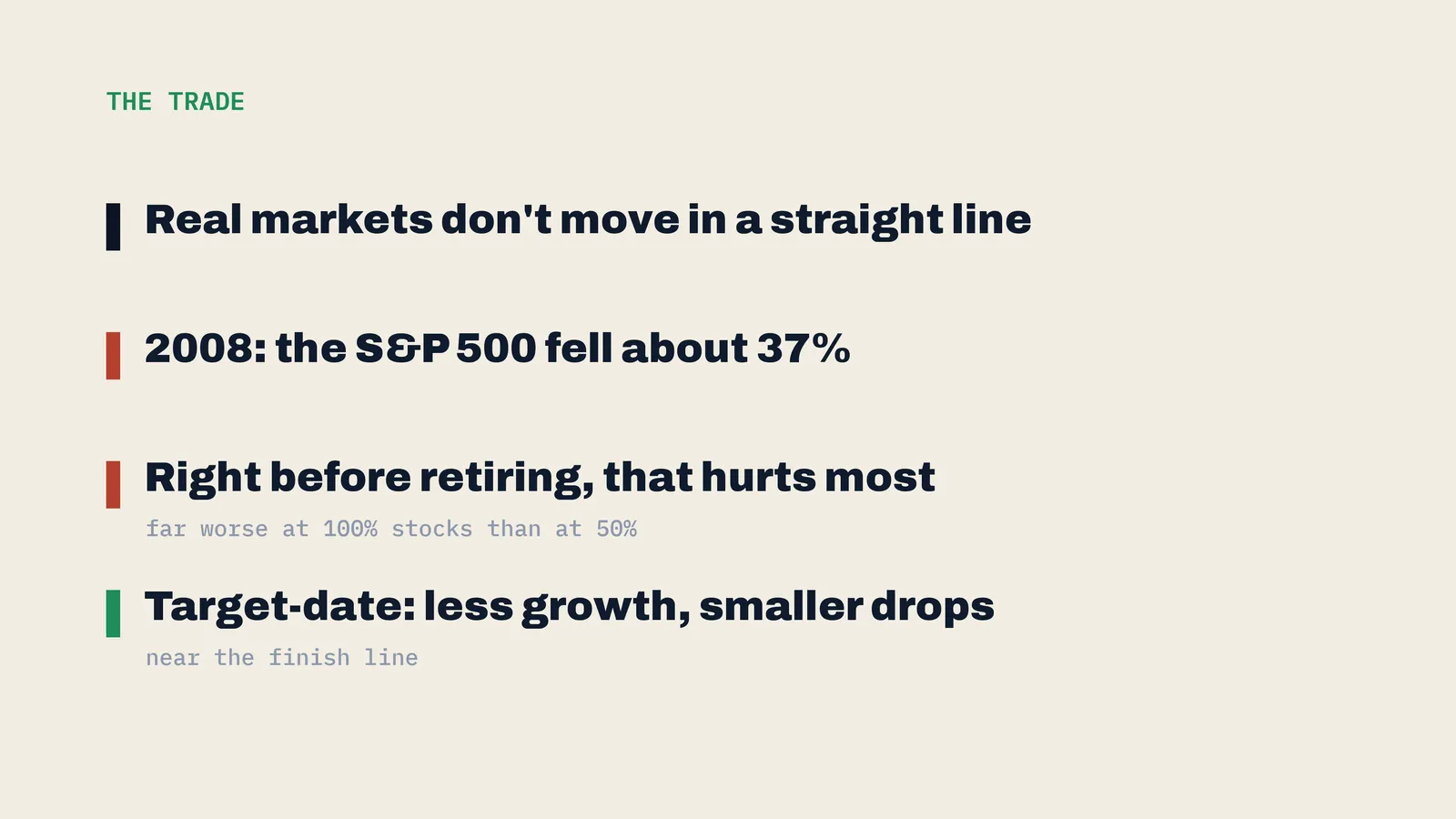
Most of that gap is the extra stocks. But real markets don’t move in a straight line: in 2008, the S&P 500 fell about 37%. A drop like that right before you retire hurts far more at all stocks than at 50%. Less growth for smaller drops near the finish line: that’s the trade.
The fee matters
Index target-date funds can cost under 0.10% a year. Some actively managed ones charge more than 0.50%.
| Fund fee | Cost by 65 vs 0.08% |
|---|---|
| 0.65% a year | $32,180 |
The Honest Check: 6% stocks, 3% bonds
| At 6% / 3% | |
|---|---|
| Target 2050 at 65 (0.08% fee) | $292,548 |
| What a 0.65% fee still costs | $23,730 |
Three rules
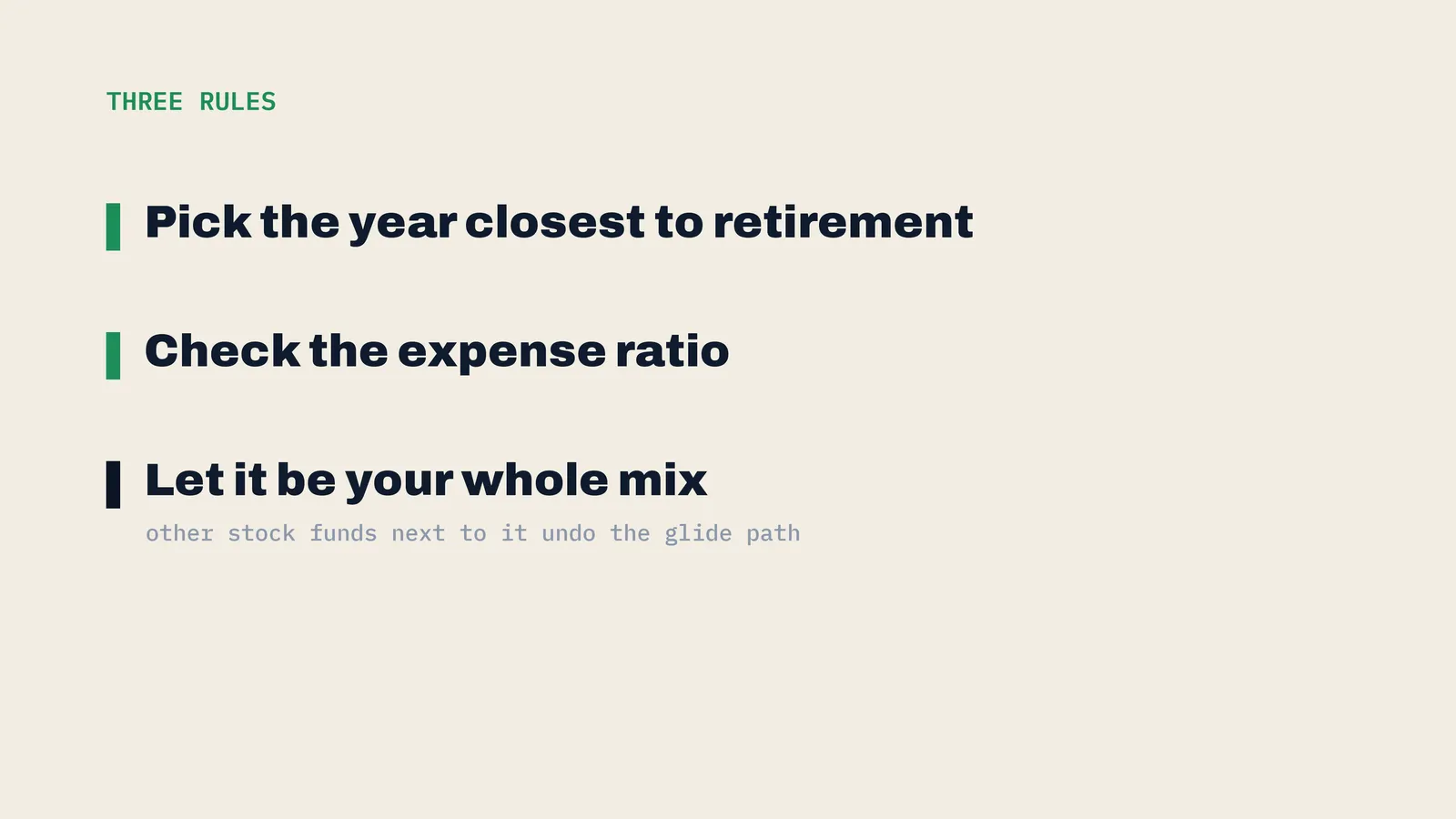
- Pick the year closest to when you’ll retire.
- Check the expense ratio.
- Let it be your whole mix. Holding it next to other stock funds undoes the glide path.
CPA Note from Daryl (tax year 2026)
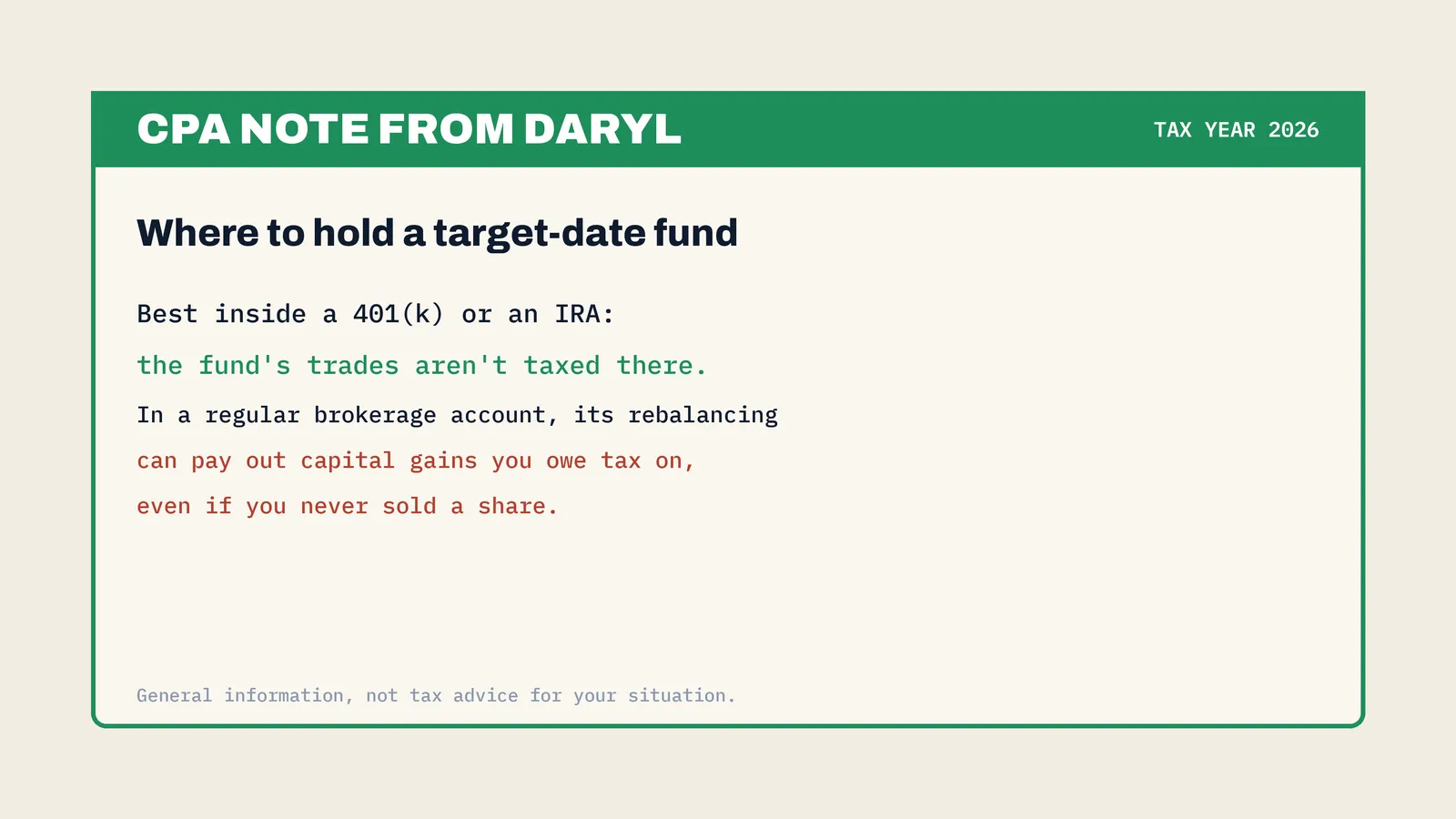
Target-date funds work best inside a 401(k) or an IRA, where the fund’s trades aren’t taxed. In a regular brokerage account, the fund’s own rebalancing can pay out capital gains you owe tax on, even if you never sold a share.
Next up: one fund rebalances for you. Build your own mix, and that job is yours. How to rebalance, and when.
How the math works
All figures come from the QWOS Target-Date Fund Calculator: age 40, retire at 65, $0 invested today, $500 a month, stocks 8% and bonds 4% (or 6% and 3%), fund fee 0.08% compared with 0.03%; then fund fee 0.65% compared with 0.08% for the fee cost. The calculator’s “100% stocks” figure uses the comparison fee. Glide path modeled on Vanguard’s published path; other fund families differ. Steady returns, monthly deposits, no taxes or inflation. 2008 S&P 500 total return: about −37%.
Education, not financial or tax advice. Hypothetical returns; real results vary and losses happen.