




Maya gets paid every two weeks: $2,769 before anything comes out. Every payday, her money goes out in the same order.
What actually lands
On the take-home paycheck calculator (10% federal rate, 4% state, 6% to her 401(k), $100 health insurance), Maya takes home $1,948.28 per paycheck.
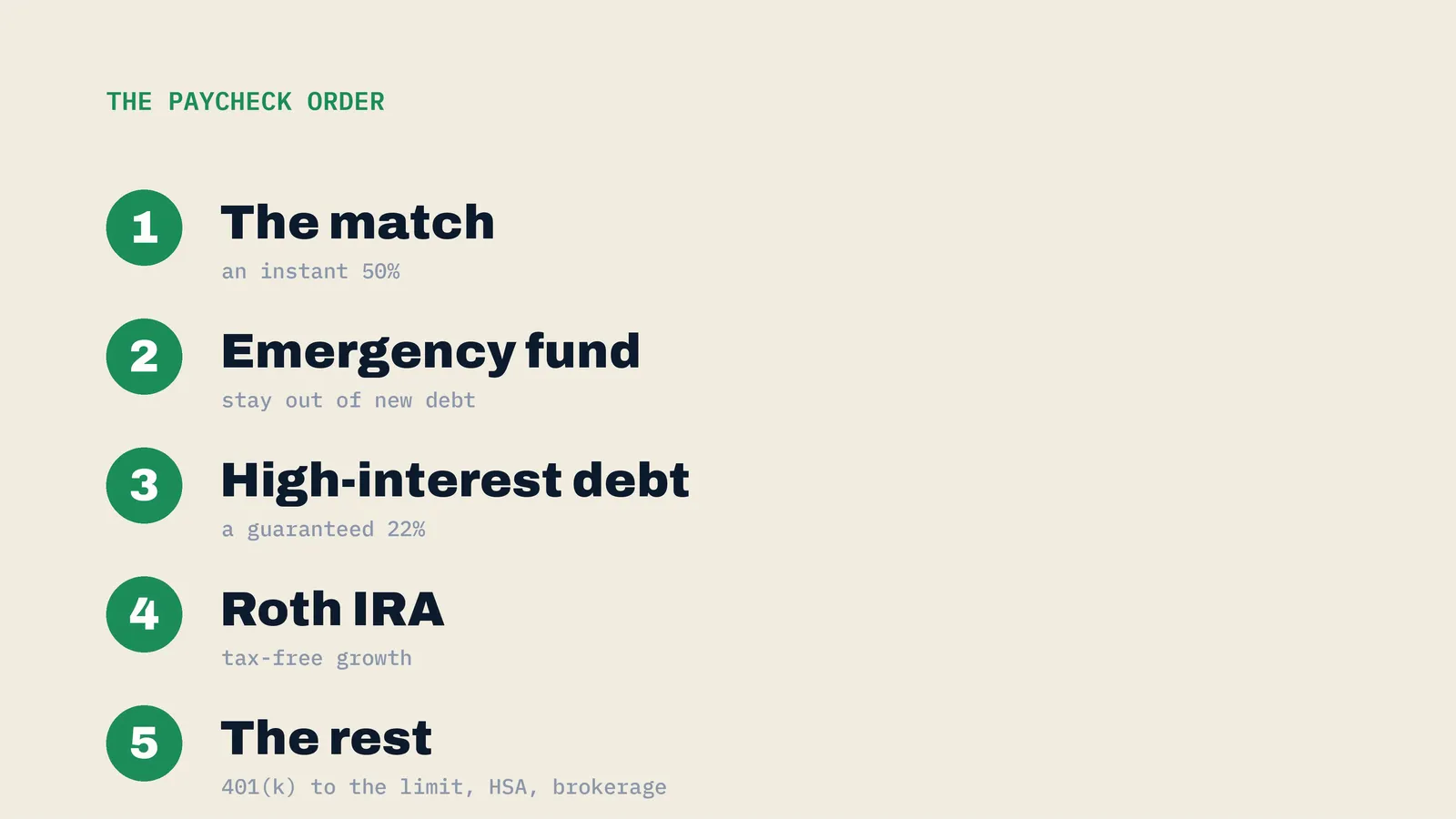
Step 1: get the full match
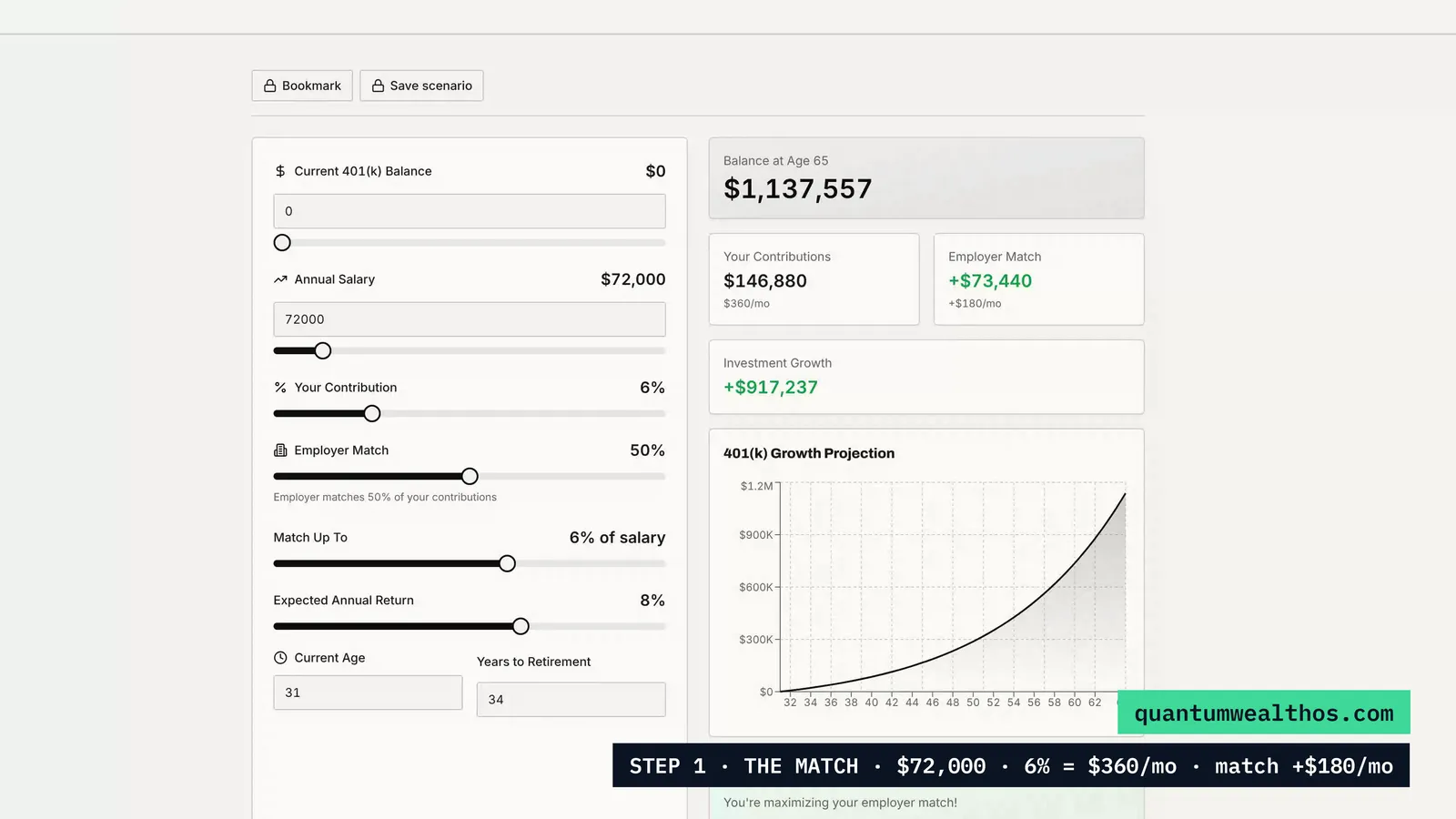
Maya’s employer adds 50 cents per dollar, up to 6% of her pay. So she puts in exactly 6%.
| 401(k) calculator, $72,000 salary, from $0 | |
|---|---|
| Her contributions | $360 a month |
| Employer match | +$180 a month |
| Balance at 65 (8%) | $1,137,557 |
| The match alone, $180/mo for 34 years | $379,186 |
It’s an instant 50% on every dollar she puts in, up to 6% of her pay.
Step 2: an emergency fund
Three months of expenses: 3 × $2,800 = $8,400. At $350 a month and 4%, two years gets her to $8,730. Six months ($16,800)? Four years gets her past it: $18,186.
Why before debt? Without a cushion, the next surprise goes right back on a credit card. Some people build a smaller starter cushion first, then hit the card hard.
Step 3: high-interest debt
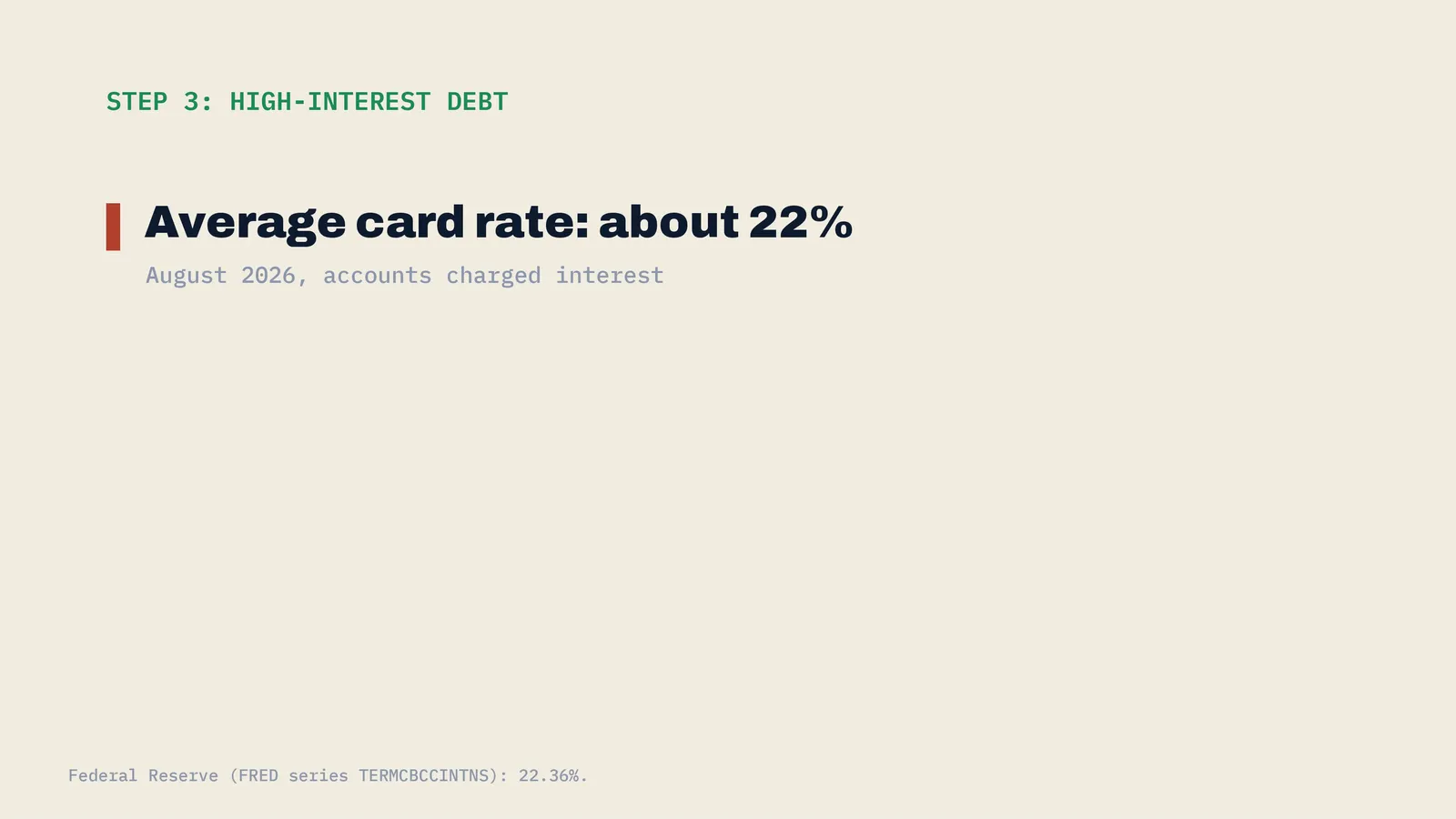
Across card accounts charged interest, the average rate was about 22% in August 2026.
| Debt payoff calculator, $3,000 at 22% | Time | Interest |
|---|---|---|
| $150 a month | 2 years, 2 months | $771 |
| $250 a month | 1 year, 2 months | $420 |
Paying off a 22% card is like earning 22%, guaranteed. Our rule of thumb: anything above 8% counts as high-interest. A low-rate car loan or mortgage can stay on its normal schedule.
Step 4: a Roth IRA
The 2026 limit is $7,500, about $625 a month. On the Roth IRA calculator, $7,500 a year from 31 to 65 at 8% grows to $1,316,617, tax-free. She puts in $255,000. Once the emergency fund is full, that $350 a month moves down the list.
Step 5: everything else
Raise the 401(k) toward the $24,500 limit (at 15%, Maya’s reaches $2,275,114 at 65), fund an HSA if you have a high-deductible plan (Episode 20), then a regular brokerage account.
Then automate it, so the money moves on payday before you ever see it.
The Honest Check: 6%
| At 6% | At 65 |
|---|---|
| 401(k) at 6% + match | $718,375 |
| The match alone | $239,458 |
| 401(k) at 15% | $1,436,749 |
| Roth IRA | $831,452 |
The emergency fund and the debt payoff don’t change, because they don’t depend on the market.
CPA Note from Daryl (tax year 2026)
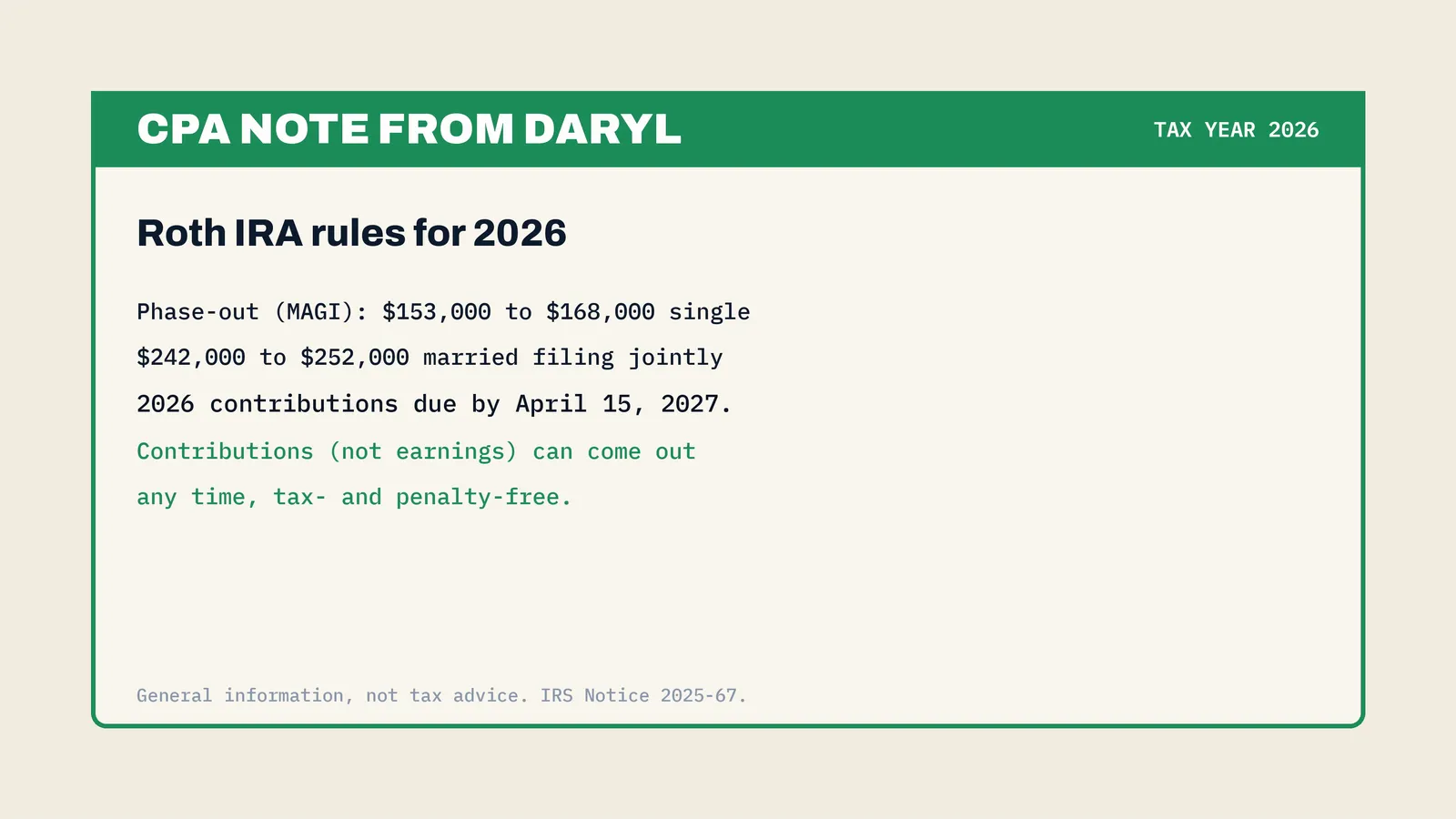
- Roth IRA eligibility phases out between $153,000 and $168,000 of modified adjusted gross income (single) and $242,000 to $252,000 (married filing jointly).
- You have until April 15, 2027, to contribute for 2026.
- The money you put into a Roth IRA (not the earnings) can come out any time, tax- and penalty-free.
Next up: earn too much for a Roth? The backdoor Roth, step by step.
How the math works
Take-home: QWOS Take Home Paycheck Calculator ($2,769 bi-weekly gross). 401(k): QWOS 401(k) Calculator ($0 balance, $72,000 salary, 50% match up to 6%, age 31, 34 years). Match alone: QWOS Compound Interest Calculator. Emergency fund: QWOS Savings Calculator at 4%. Card: QWOS Debt Payoff Calculator. Roth: QWOS Roth IRA Calculator ($7,500 a year, age 31, 34 years). 2026 limits and phase-outs: IRS Notice 2025-67. Card rate: FRED series TERMCBCCINTNS (22.36%, August 2026).
Education, not financial or tax advice. Hypothetical returns; real results vary and losses happen.