



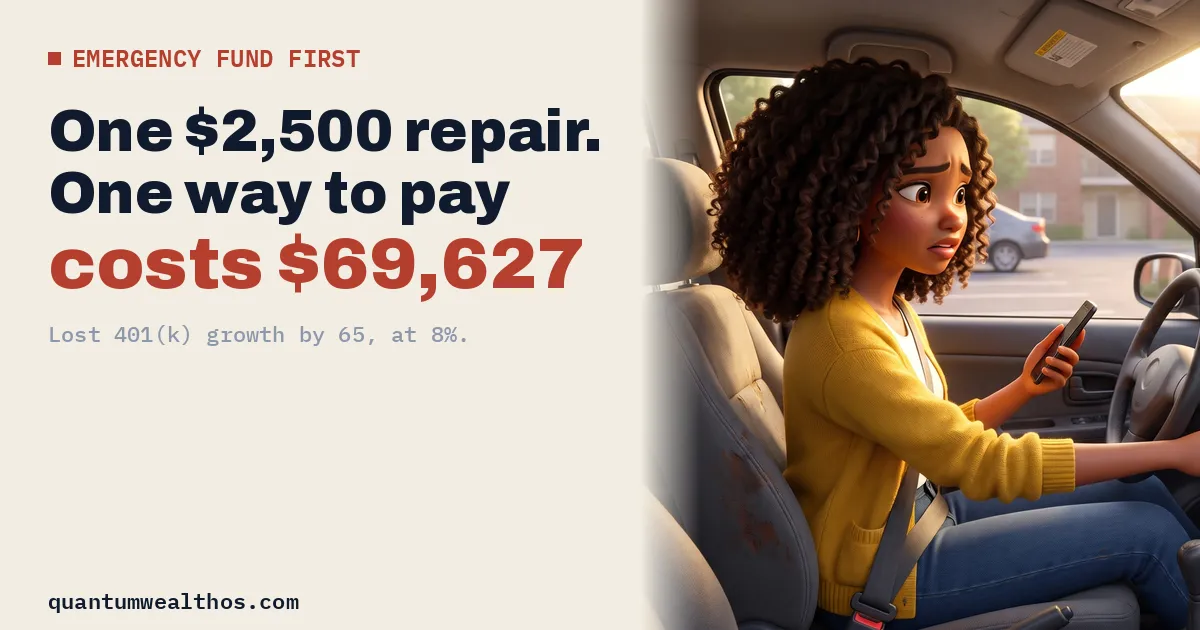
Maya is 25. She invests every month. Then, on a Tuesday morning, her car won’t start. The mechanic says $2,500.
As Marcus puts it: “The repair wasn’t the expensive part. How I paid for it was.”
The $400 question
Every year the Federal Reserve asks adults: could you cover a surprise $400 expense with cash? Only 63% said yes. Maya’s bill is more than six times that.
She has four ways to pay. We ran every one.
Option 1: The credit card
At 19.67% APR, the average card rate:
| How she pays | Time to pay off | Interest | Total paid |
|---|---|---|---|
| $100 a month | 33 months | $743 | $3,243 |
| Minimum payments only | about 25 years (298 months) | $7,062 | $9,562 |
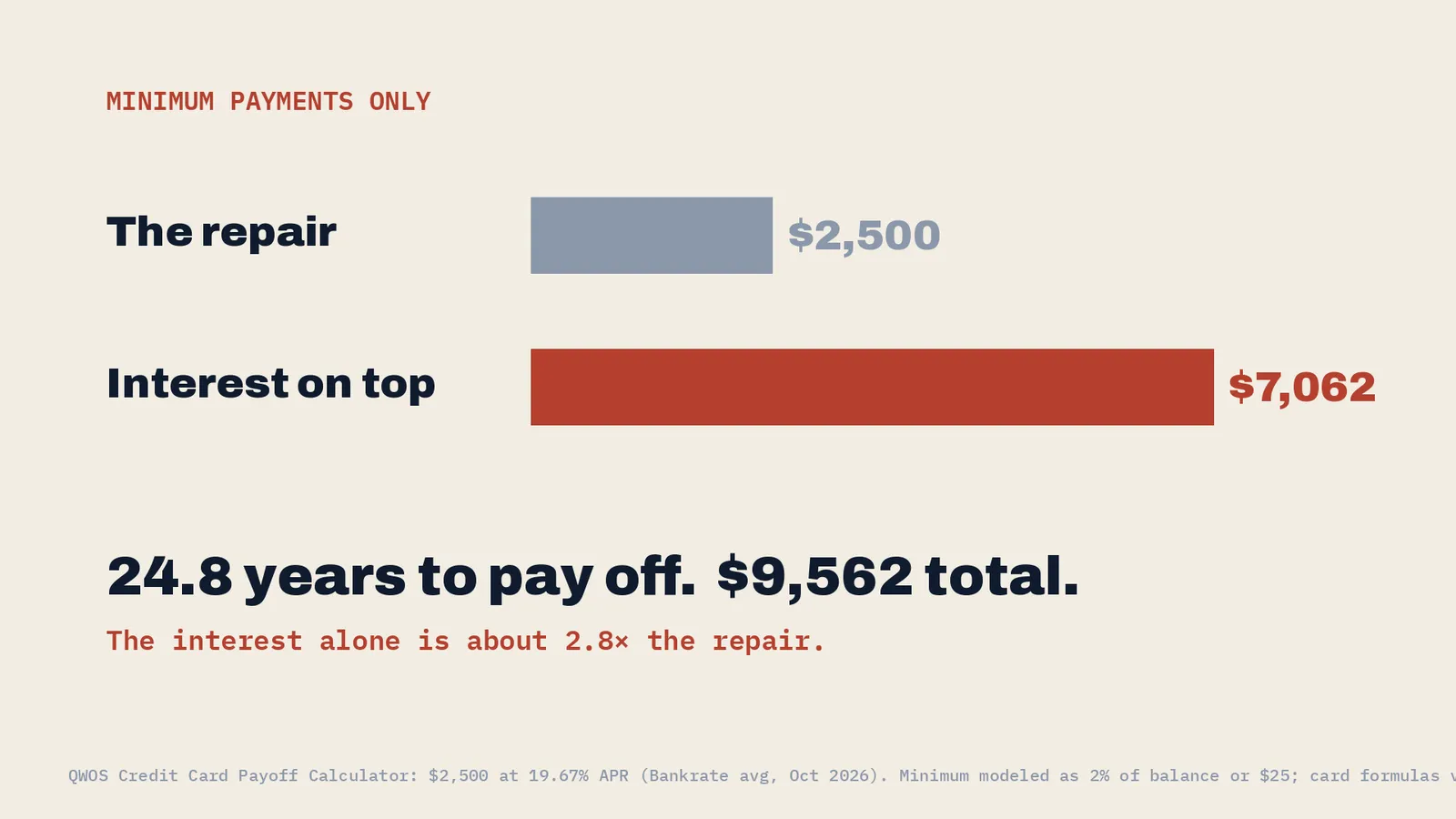
Paying only the minimum, the interest alone is about 2.8 times the repair. (The calculator models the minimum as 2% of the balance or $25, whichever is more. Card issuers’ formulas vary.)
Option 2: Raid the 401(k)
Before age 59½, an early withdrawal usually means a 10% penalty plus income tax. To walk away with $2,500 in the 12% federal bracket, she has to pull out $3,205:
| Amount | |
|---|---|
| She withdraws | $3,205 |
| 10% early-withdrawal penalty | −$321 |
| 12% federal income tax | −$385 |
| What she actually gets | $2,500 |
And that money stops growing. Left invested, $3,205 could be about $69,627 at 65 at 8% (about $32,966 at 6%).
CPA Note from Daryl (tax year 2026). SECURE 2.0 added an emergency exception starting in 2024. One withdrawal a year, up to $1,000, can skip the 10% penalty. It’s still taxed as income, you can repay it within 3 years, and your plan has to offer it, so check first. Either way, that money stops growing. General information, not tax advice for your situation.
The Honest Check: change one assumption
Her tax bracket. In the 22% bracket, getting $2,500 in hand means pulling about $3,676, and $1,176 is gone on day one.
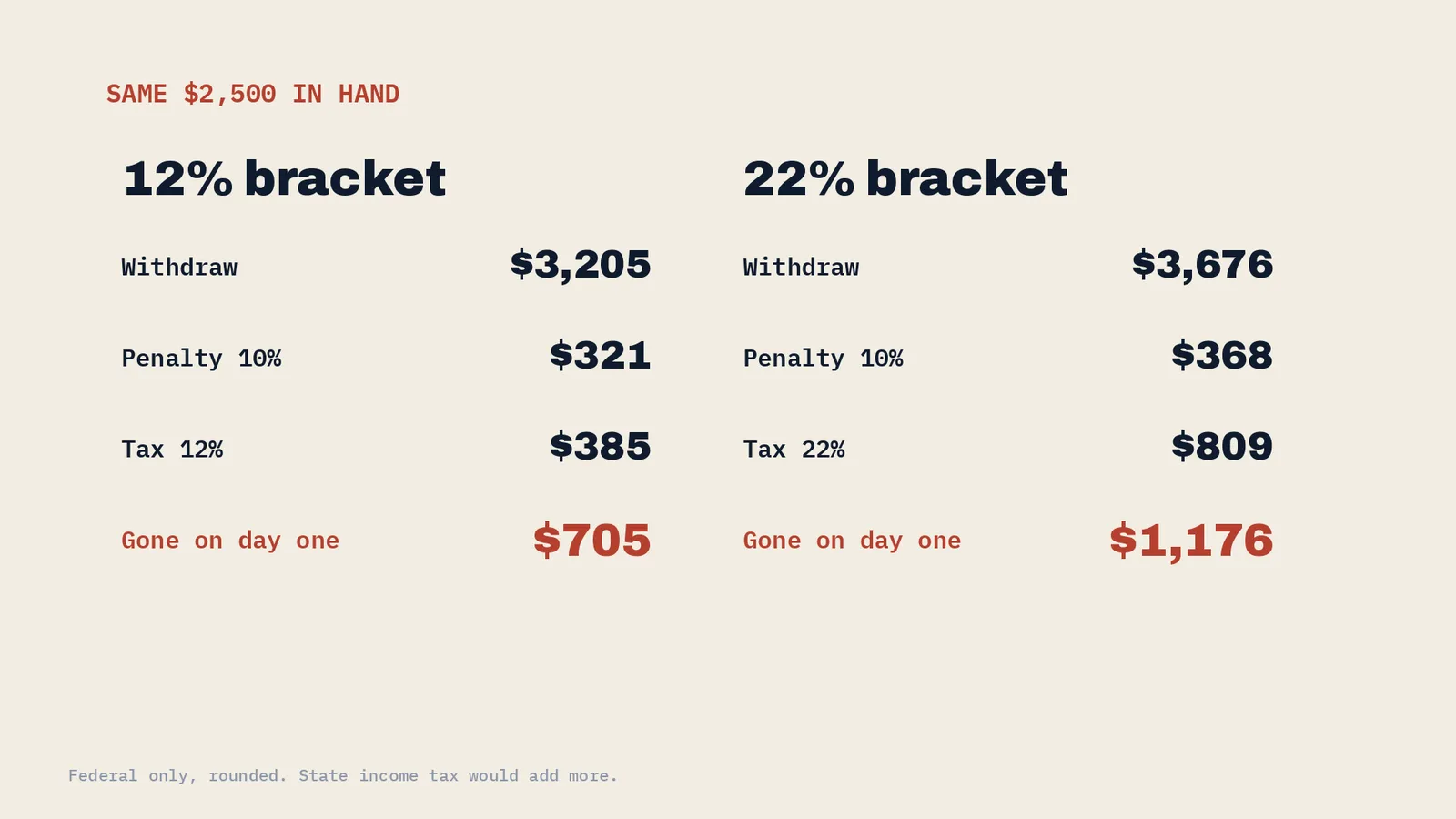
These are federal numbers, rounded. State income tax would add more.
Option 3: Sell her investments
In 2022, VOO fell about 18%. Needing cash that year meant selling at a discount, right before the 2023 rebound. Selling in a down year locks in the drop.
Option 4: The emergency fund
She moves $2,500 from high-yield savings and pays the bill. Total cost: $2,500. Same day, no interest, nothing lost.
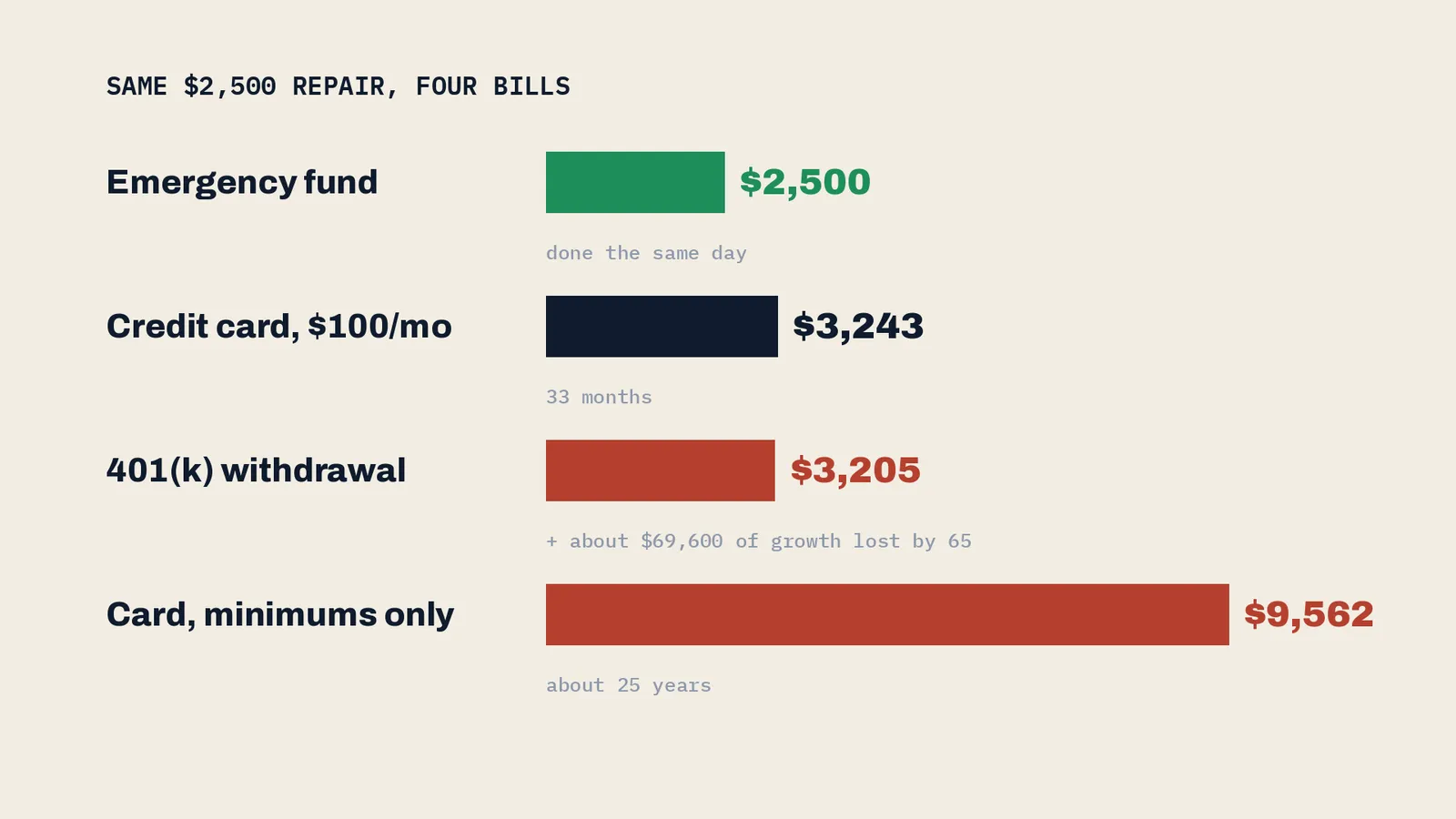
| How Maya pays | What it really costs |
|---|---|
| Emergency fund | $2,500 |
| Credit card, $100 a month | $3,243 over 33 months |
| 401(k) withdrawal | $3,205, plus about $69,627 of growth lost by 65 |
| Credit card, minimums only | $9,562 over about 25 years |
How much, and where?
Three to six months of expenses. Maya spends about $2,800 a month, so her target is $8,400 to $16,800.
Start with one bill-sized goal. $200 a month at 4.3% reaches $2,448 in 12 months, and passes $2,500 in month 13.
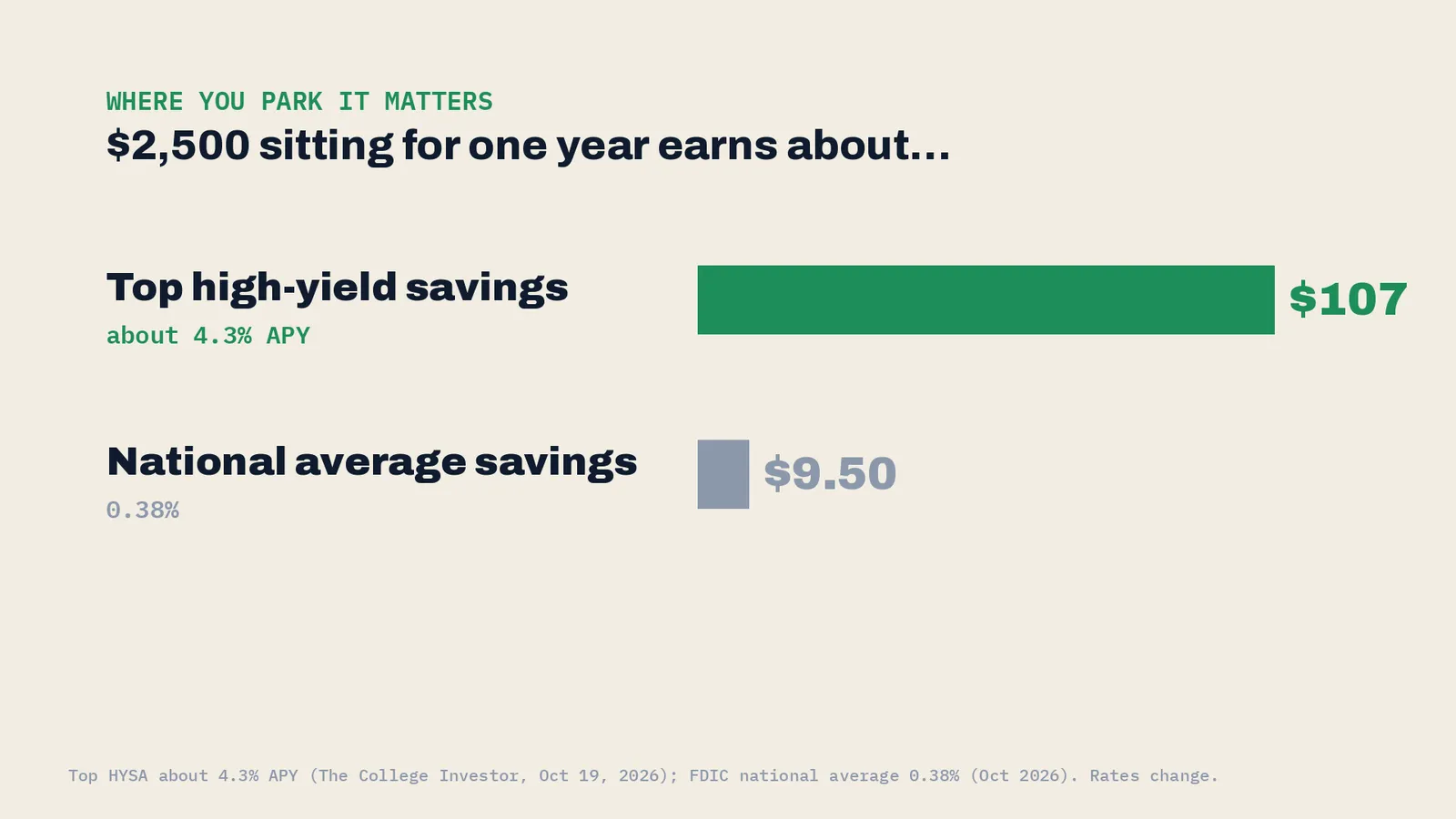
Where you park it matters. $2,500 sitting for a year earns about $107 at a top high-yield savings rate (about 4.3% APY), and about $9.50 at the national average (0.38%).
Does this mean stop investing?
No. Keep grabbing your 401(k) match while you build the fund. An emergency fund doesn’t make you rich. It keeps one bad Tuesday from undoing everything that does.
Next up: the 401(k) match, the closest thing to free money most jobs offer.
How the math works
Credit card figures come from the QWOS Credit Card Payoff Calculator below ($2,500 at 19.67% APR). The lost-growth and savings figures come from the QWOS Compound Interest Calculator: $3,205 left invested for 40 years, compounded annually; and $200 a month at 4.3% for one year, deposits at month end.
Education, not financial or tax advice. Projections assume steady returns; real returns vary and can be negative.
Sources: Federal Reserve, Economic Well-Being of U.S. Households in 2025 · Bankrate average card APR, 19.67% · High-yield savings rates, Oct 19, 2026 · SECURE 2.0 emergency exception (Haynes Boone) · VOO vs QQQ annual returns (ChartRow)